

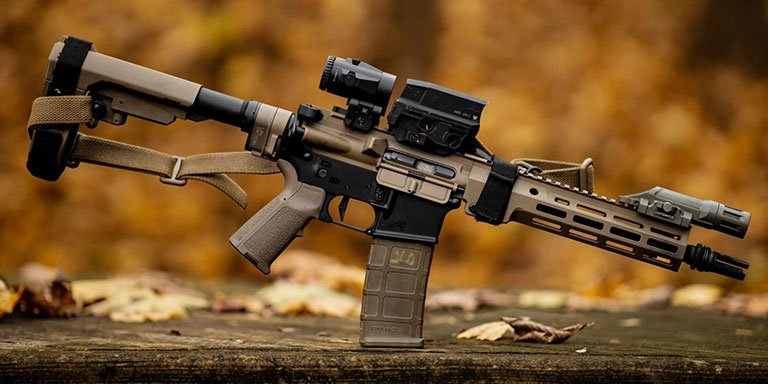
The AR pistol is a unique weapon that, in most cases, consists of the upper and lower receiver of an AR-type rifle, yet fits the definition of a pistol. The gun was developed, in part, to get around the National Firearms Act regarding short-barreled rifles.
The AR pistol allows a shooter to have a weapon similar in size, weight and compact maneuverability to that of a short-barreled rifle. They are a great combination of a handgun's concealability with a rifle's firepower and can be chambered to accept many different rounds. These weapons became popular using a relatively newly developed stabilizer brace. The brace dramatically increases the stability of the gun, which is designed to be fired with one hand.
Consider holding a standard AR-15 rifle with one hand using only the pistol grip to hold, point, aim and fire the weapon. This is a very shaky, if not impossible shooting platform for even the most experienced shooter. All this changed with the stabilizer brace.
The National Firearms Act
In the evolution of this newer class of weapon, it's first important to understand how a firearm gets its classification as a pistol (and not a rifle), or the separate classification of SBR (short-barreled rifle).
In 1934, the National Firearms Act was passed, which defined weapons classifications. Part of this early definition is that the minimum barrel length of a rifle is at least 16 inches, and the minimum barrel length of a shotgun is 18 inches. Rifles and shotguns are designed to be shoulder-fired weapons.
A handgun or pistol, on the other hand, must be designed to be fired with only one hand. It is important to note that there is no maximum barrel length in the handgun classification.
Problems with the SBR
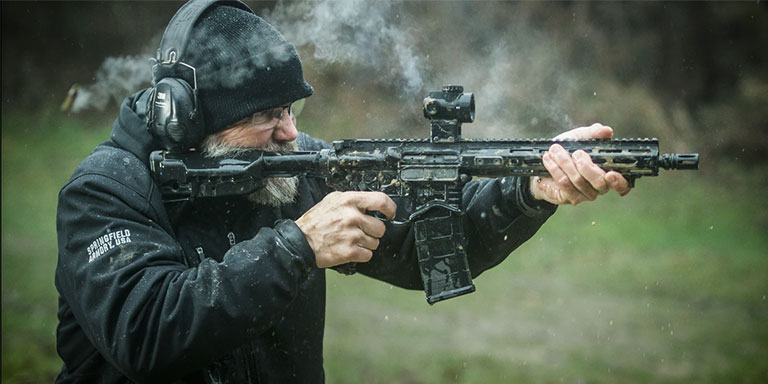
The short-barreled rifle is a separate federal classification. It's a shoulder-fired weapon with a barrel length of less than 16 inches. It must receive a separate federal tax stamp purchased for two hundred dollars. In 1934, the two hundred dollar tax was considered prohibitive, but this tax has never increased over time. The weapon has to be federally registered, and the design must be approved. If the extra two hundred dollar tax was the only consideration, SBRs might be more popular, but it gets more complicated.
Applying for a short-barreled rifle can be a lengthy process. All paperwork has to be submitted to the Department of Alcohol Tobacco and Firearms (ATF) and can take many months to be approved. Additionally, if the owner of a federally registered SBR wants to take it out of state, the ATF must be notified and approve the transport in advance. This makes it nearly impossible to take an SBR on a last-minute trip out of town.
The additional cost, federal registration, lengthy approval process, and other restrictions made application for SBRs very unpopular. The stabilized AR pistol became the answer for many who didn't want to deal with the paperwork and federal red tape involved in applying for a short-barreled rifle.
The AR Pistol
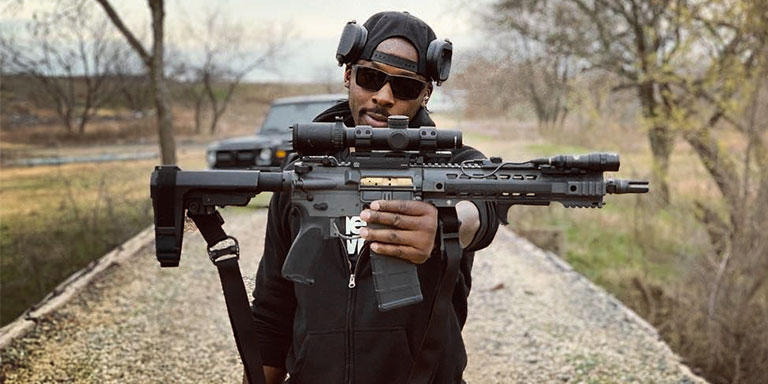
The development of the AR pistol began with a reconfiguration of an AR rifle, eliminating the shoulder stock and designing the pistol to be fired with just one hand. These changes mean that the weapon is no longer a shoulder-fired weapon, but rather a pistol that can be fired with one hand (remember too that the minimum barrel length of 16 inches doesn't apply to pistols). Most commercially designed AR pistols have much shorter barrels for overall weight reduction, compactness and better weapon balance when using one hand.
There was, in fact, a minuscule AR pistol market before the invention of the stabilizing brace. The weapons were difficult to shoot, though, and were not well received as a result. If the owner wanted to add a shoulder stock, they had to file the federal paperwork and pay the two hundred dollar tax stamp for a short-barreled rifle; otherwise they'd be violating federal law.
While the redesigned AR pistols can be chambered to many rifle calibers and even some handgun calibers, the 5.56 AR-15 is still by far the most popular. One advantage of this weapon design is the extended rear recoil tube necessary for the weapon to operate. Without this one essential appendage, the weapon might never have become so popular.
Invention and Development of Stabilizing Braces
US military veteran Alex Bosco returned from duty overseas and took one of his friends to a local rifle range. His friend was a disabled combat veteran who experienced difficulty controlling the AR-type weapon with only one hand. Alex Bosco left the range that day committed to finding a better way to enable his friend to shoot using a stabilized pistol grip.
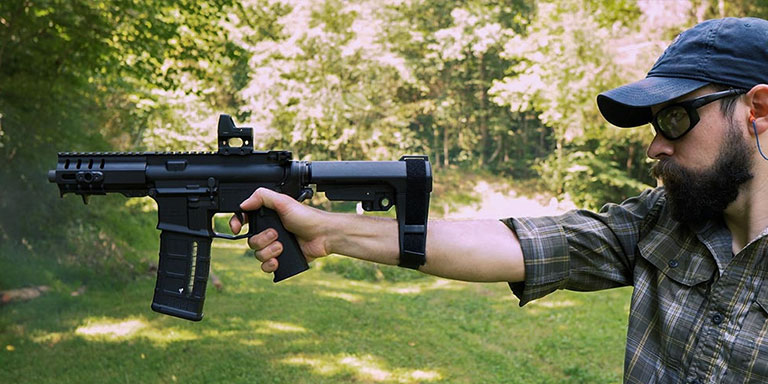
Alex invented a pistol stabilizing brace made of a rubber-like material. With the rifle stock removed, the brace is slid over the slides of the buffer tube. Two rigid wing-type structures straddled the shooter's forearm and secured via a hook-and-loop strap. This locked the weapon onto the disabled shooter's forearm, allowing for a more stable shooting platform using only one arm and enabling the shooter to fire the weapon like a pistol.
As a result of the stabilizing brace Alex made for his friend, he went on to start a successful company, patenting his brace design. The pistol stabilizing brace was evaluated by the ATF, who approved it. Because it was made of a soft material, it was not suitable for shouldering and therefore was not considered a stock.
In 2013, with his ATF approval letter, Alex met with several firearm companies seeking a partner to manufacture the stabilizing brace. Two companies adopted the pistol brace system, but it became well known when Sig Sauer introduced a line of Sig AR pistols with the now-famous “Sig brace.”
Moving far beyond simply helping disabled shooters, these stabilizing braces reignited the AR pistol market, with millions of braces having been sold. Now all shooters can enjoy increased stability in shooting the AR pistol. Securing the pistol to the shooter's forearm allows for greater control and accuracy while remaining within the confines of a pistol classification.
Current and Future Considerations
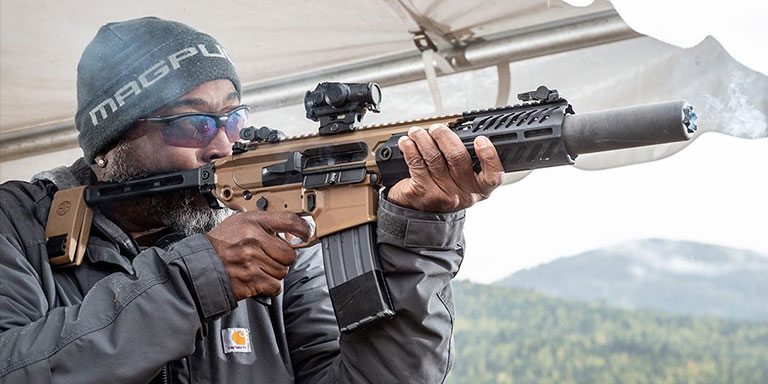
Although Alex's new brace design was ingenious, we must issue a word of caution: rest one of these stabilizing braces against your shoulder, and you could violate federal law. You would, by definition, be using an AR pistol as an AR rifle without the proper classification, and of course, the two hundred dollar tax stamp. While the ATF approved the stabilizing brace in 2012, they have been reconsidering the issue ever since.
In 2015 the ATF, in an open letter, pointed out that their rifle and shotgun definitions include the phrase “a weapon designed or redesigned, made or remade, and intended to be fired from the shoulder.” However, the definition doesn't elaborate on what the word “redesign” means. It seemed to indicate that anyone who shoulders a pistol with a brace has “redesigned” the gun to act as an unregistered short-barreled rifle, which is a felony. As a result of this letter, AR pistol sales started to fall. Shooters didn't want to violate federal law if the brace touched their shoulder, either intentionally or unintentionally.
The stabilizing brace manufacturer's attorneys questioned the letter and received a written response that was made public in 2017. In this letter, the ATF seemed to reverse their earlier guidance. They indicated that using a stabilizing brace in a manner other than what it was designed for does not automatically constitute a weapon redesign or change the weapon's classification to that of a short-barreled rifle.
The only thing clear in this exchange of letters is that the issue has not been completely decided. The ATF could change its ruling at any time regarding the legality of stabilizer braces. While AR pistols continue to be popular, their owners need to remain vigilant to federal authorities' ever-changing guidance.
State laws are just as important as federal laws. Some states do not allow AR pistols and have their own set of more restrictive laws. Calling the local ATF office in your home state can provide some guidance — they will have the most up-to-date information on the current status of gun laws and definitions.
AR pistols fitted with properly functioning stabilizing braces bridge a gap between pistols and rifles. Add some available optics, and they provide good medium-range accuracy with the increased firepower of a rifle round. AR pistols are also smaller and easier to conceal than the standard 16-inch barrel rifle. They are weapons that are fun to shoot at the range and are more than capable of being used for home defense.
Most AR pistol shooters will admit that beyond performance, they also have an extremely formidable appearance. Many look like the small tactical entry guns used by SWAT teams. Classified as a pistol and combined with increased firepower, enhanced stability and a cool, tactical appearance, AR pistols are unique weapons whose popularity continues to persist.