

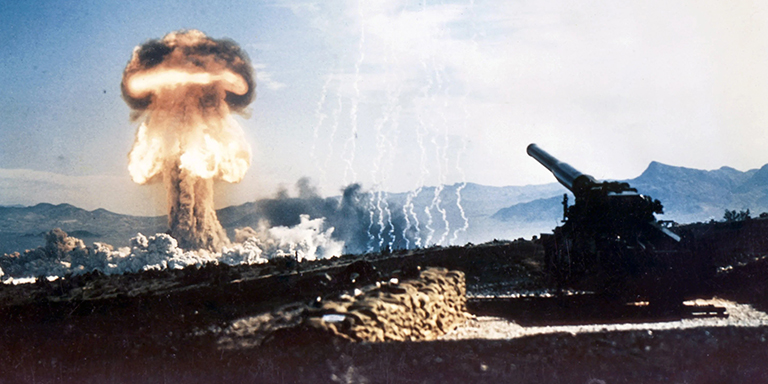
Fortunately, no nuclear weapons have been detonated since the end of World War II (outside of testing environments). Even so, they remain a prominent factor in international politics, especially during wartime.
Tactical nukes are usually smaller and less destructive than their strategic counterparts (like the famous Fat Man and Little Boy), and they serve a very different purpose. Whereas strategic nuclear weapons are intended to inflict devastating damage on entire cities or other large non-military targets, tactical nukes are meant to be used against much smaller targets on or near the battlefield.
In this guide, we'll briefly review the history of tactical nuclear weapons and how they work. We'll also go over their destructive capacity, intended uses and the role they play on the global stage.
History and Reasons for Development
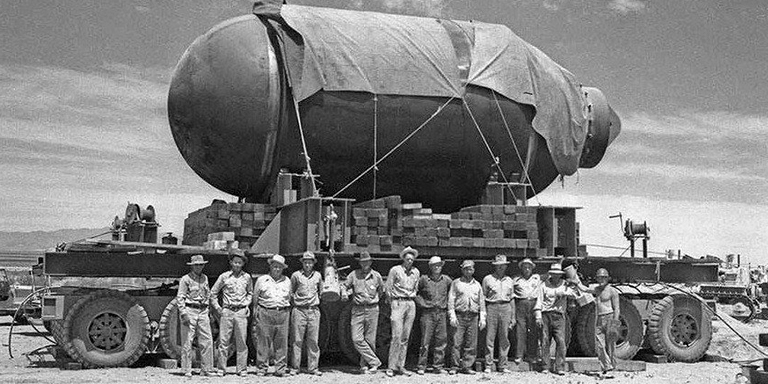
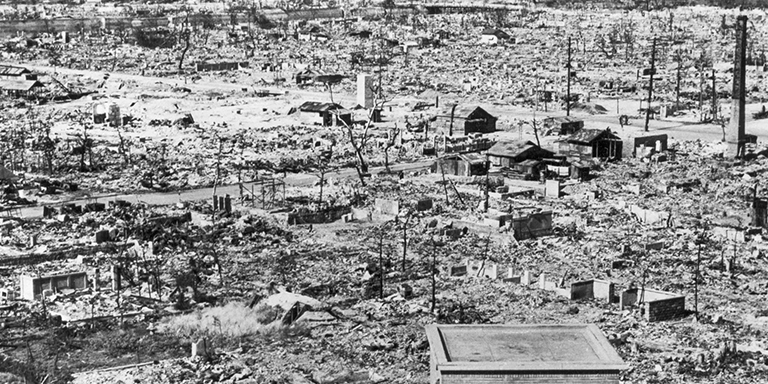
Most historians agree that Japan never would have surrendered in World War II unless they were dealt a crushing and unequivocal defeat. That's why President Truman authorized atomic weapons to be dropped on Hiroshima and Nagasaki. After the end of the war, the powers that be realized that nuclear weapons could be more useful (and less horrifyingly destructive to civilian populations) if they were scaled down. By the mid-1950s, the first tactical nuclear prototypes were being rolled out. These weapons were capable of utterly destroying targets much smaller than a city in a more controlled and predictable manner, making them more viable as battlefield weapons.
Modern tactical nukes can be delivered by airplanes, submarines, stationary silos, ground vehicles and even man-portable launchers. This wide range of deployment options means that, at least in theory, any place on Earth could be hit by a nuclear strike within 12 hours.
That's a scary thought, but fortunately, tactical nukes have never been used against live targets, and it's highly unlikely that they will be anytime soon (for reasons we'll get into later).
How Do Tactical Nuclear Weapons Work?
Nuclear science is, of course, one of the most complex and difficult fields of study. In a short guide like this one, we can offer only the most simplistic explanation. On the most basic level, strategic and tactical nuclear weapons work the same way — the difference between them is mostly one of scale.
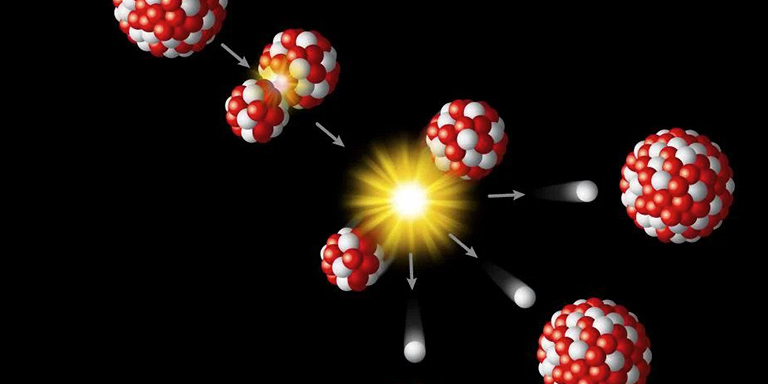
Nuclear weapons use one of two processes to create an explosion: either fission or fusion (and fusion also utilizes fission to some extent). Fission is the process by which an atom, one of the smallest known units of matter, is forcibly split. For some very complicated scientific reasons we can't begin to explain here, this splitting releases a tremendous amount of energy. In a nuclear weapon, this causes nearby atoms to split in a chain reaction that unfolds in as little as one hundred-billionth of a second, producing a catastrophically powerful explosion.
Neutron bombs are a subtype of fission bomb. They produce a much smaller explosion, but release far more deadly radiation. Theoretically, they'd be used as anti-personnel weapons when minimal damage to infrastructure is desirable.
Fusion weapons smash atoms together instead of splitting them. This produces even more energy than fission alone, making fusion weapons more powerful. But they're also more complicated, expensive and dangerous to build.
Contrary to popular belief, "dirty bombs" are not nuclear weapons at all; they utilize neither fission nor fusion. Instead, they combine radioactive material with conventional explosives, producing kinetic damage and radioactive fallout that, while still very dangerous, are far inferior to those produced by a nuclear weapon.
Destructive Capacity
The destructive capacity of a nuclear weapon is typically measured in kilotons. A kilton is one thousand tons, and a one-kiloton nuclear weapon has the destructive capacity of one thousand tons of TNT. It's difficult to segregate types of nuclear weapons by their destructive capacity because there's a lot of variance and overlap. Some tactical nukes even have variable payloads, meaning they can be tweaked just before deployment to create a larger or smaller explosion.
Yields range from ten tons to 50 megatons. Tactical nukes generally have smaller yields than strategic weapons like the ones deployed in WWII, but there are exceptions.
Tactical nukes cause damage in three simultaneous ways: the physical energy of the blast, heat and radiation. Some weapons are designed to cause damage primarily in one of these ways while mitigating the others. The smallest tactical nuclear weapons ever developed are "only" capable of destroying entire neighborhoods, whereas the biggest (around 200 kilotons) are several times more powerful than the bombs that destroyed Hiroshima and Nagasaki.
Types and Examples
Although there are dozens of types of tactical nuclear weapons, the majority of those used by America are (or were) one of the following. Other countries that have nuclear capabilities generally develop their own weapons, but they're all fairly similar to ours.
B57 and B61 Bombs
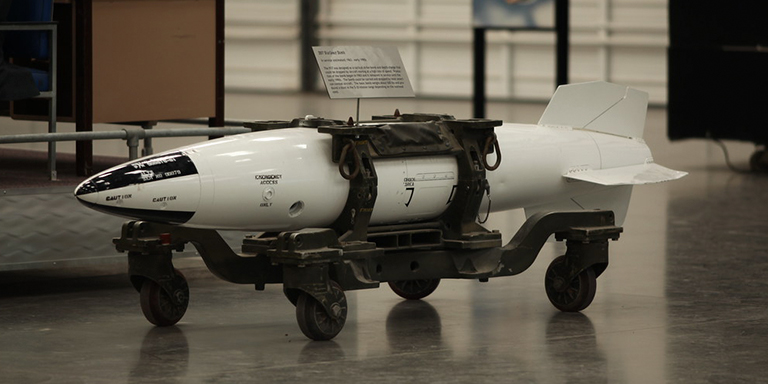
The bulk of America's current nuclear weapon stockpile consists of leftovers from the Cold War. Both the B57 and B61 bombs are designed to be delivered by aircraft, and both come in various yields ranging from 0.3 to 340 kilotons. Both can be detonated in the air (airburst), upon impact with the ground (groundburst), or after a timer expires (laydown mode).
W25 and W85 Warheads
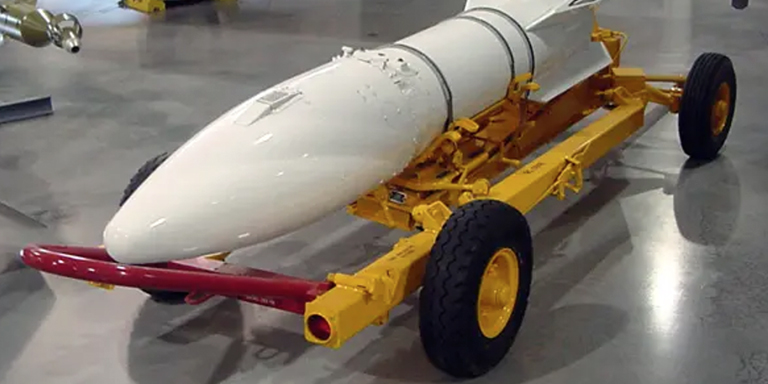
The W25 was a small warhead (by nuclear standards) developed in the 1950s, with a yield of 1.5 kilotons. Originally designed for use in air-to-air rockets, it was retired in the mid-80s, and older units were converted or recycled.
The W85 was a selectable-yield warhead (up to 80 kilotons) developed in the late 60s. Due to various technical and logistical problems, it was quickly abandoned, and existing units were converted to B61 bombs.
M28 Davy Crockett
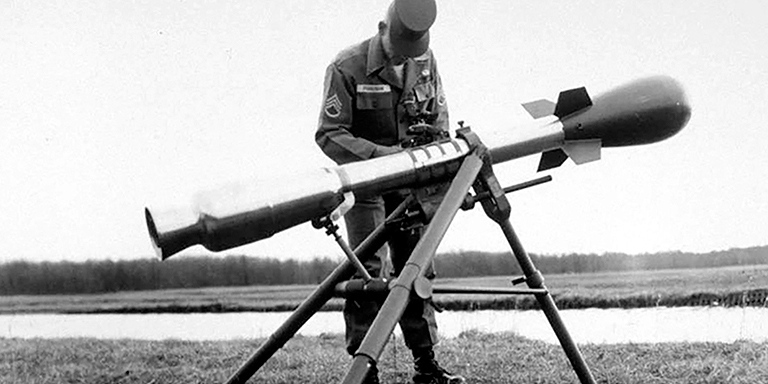
The Davy Crockett was the first (and to date, the only) man-portable nuclear weapon ever developed. It was a recoilless rifle that theoretically could be moved, set up and fired by a single person, if need be. It was designed to fire the W54 warhead, the smallest nuclear warhead ever to enter U.S. service with a yield of "only" 20 tons.
Testing revealed the weapon to be "shockingly inaccurate," and it was retired sometime in the 1960s.
MADM/SADM
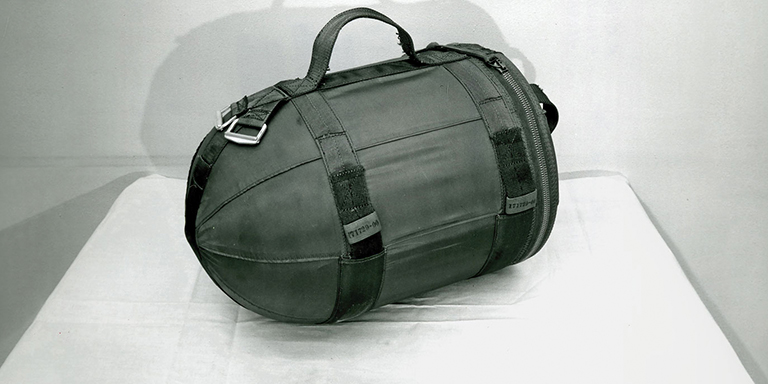
Uniquely, the MADM (Medium Atomic Demolition Munition) and the SADM (Special Atomic Demolition Munition) were designed to be used as placed explosives, not launched or dropped from aircraft. Provided combat engineers had sufficient time to set them up carefully, they could produce relatively controlled nuclear explosions to destroy buildings, tunnels, and bridges with minimal unintended damage. The larger MADM could produce explosions up to 15 kilotons, but it was too heavy for one person to carry; the much more portable SADM had a yield up to 1 kiloton.
Small numbers of these explosives remain in the U.S. nuclear stockpile, but because their designs are now 60 years old, they would likely be redesigned before being deployed in combat.
Theoretical Battlefield Applications
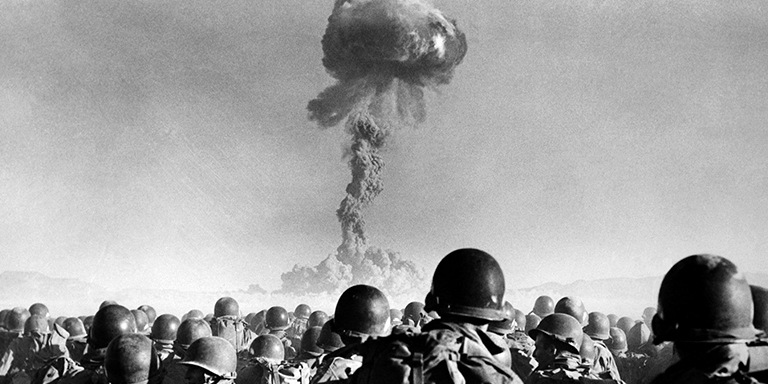
Tactical nuclear weapons have a number of uses on the battlefield, most of which are variations on the same basic idea: to ensure total destruction of hard, relatively small targets in situations where larger nuclear weapons would be overkill. Targets against which the U.S. military might someday use tactical nukes include large enemy military bases, critically important infrastructure in hostile territory or otherwise impenetrable locations such as underground caves.
Like strategic nuclear weapons, tactical nukes irradiate the area of detonation, usually rendering it uninhabitable for some time. In most cases, the radiation is less severe and doesn't last as long due to the generally lower yield of the explosion. However, some tactical nuclear weapons, like the neutron bomb we mentioned earlier, could be used as anti-personnel weapons while leaving infrastructure somewhat intact and usable.
Obviously, tactical nuclear weapons have severe drawbacks. Military strategists and foreign policy experts usually agree that the use of tactical nuclear weapons in combat would almost certainly carry a high risk of escalating a conflict, potentially leading to all-out nuclear war. All of the nuclear weapons in the world today, combined, could wipe out all of humanity about thirty times over.
Despite their incredible destructive power, nuclear weapons can be tremendously powerful peacekeeping tools, as explained by the theory of mutually-assured destruction (MAD). This theory postulates that if any country were to use nuclear weapons against another, that country (or its nuclear-capable allies) would likely retaliate in kind, having nothing to lose at that point. In all but the most dystopian scenarios, the threat of global nuclear winter will surely be sufficient to keep any country from ever crossing that line.
Which Countries Have Tactical Nuclear Weapons Today?
Only a handful of countries have (or claim to have) the technology and resources to develop nuclear weapons. The list of countries that possess nuclear weapons is much shorter than most people realize. It's divided into two subcategories: countries known to possess nukes and those that claim to but haven't proven it.
Only the United States, Russia, the U.K., France, and China are known to have both functional nuclear weapons and the technology to use them. India, Pakistan, and North Korea have claimed to have nuclear capabilities, but based on what we know about these countries, only India's claim is plausible.
Israel is a strange and unique case, at least in this context. Its people are in an exceedingly difficult position, both politically and militarily, which is probably why its government won't say whether it has nuclear weapons or not. Most experts agree that Israel probably does have nuclear capability, given how advanced and effective its military has proven to be.
Even though there are some deplorable conflicts that have cropped up since the development of nuclear weapons (such as 9/11, the Israeli-Palestinian conflict and Russia's invasion of Ukraine to name a few), the use of tactical nuclear weapons remains extremely unlikely, with strategic nuclear deployment being an even more remote possibility. The last few decades have given us plenty to worry about, but thankfully, nuclear war needn't be on the list.