

Tens of millions of Americans own firearms for self defense, and fortunately, few ever have to use them for that purpose. You're likely already proactively training to defend yourself if you're ever attacked, but if you haven't given a lot of thought to your legal defense before you draw your weapon, you're already way behind the curve.
In this guide, we'll outline the most essential steps to take now to maximize your odds of a favorable legal verdict after using your weapon in self-defense. Note that the advice in this article is specific to the United States, is general, and can't replace the specific advice of a qualified attorney.
When, Where, and Why Can You Draw a Firearm in Self-Defense?
As is the case with all complex issues, protecting yourself both physically and legally starts with a ton of good research. Your gun-related freedoms and responsibilities vary from state to state, and sometimes from county to county. Before you ever strap on your CCW gun, learn your local laws and set a reminder to check for changes a few times per year.
Learn the laws governing which types of firearms and firearm accessories are legal in your area, as well as those governing concealed carry, as applicable. If you use an illegal or illegally concealed firearm, you could be charged with a crime independent of whether your act of self-defense was otherwise legal.
In general, in order to lawfully discharge a firearm in self-defense, you must meet three criteria:
1. Credible Threat
There must be an imminent threat of grave bodily harm to you or to another person. With few and limited exceptions in a small number of states, you can't use lethal force to defend property unless there is also an imminent threat to a person.
2. Proportional Force
Your use of force must be proportional — that is, not excessive given the threat posed by the attacker. If the attacker is wielding a deadly weapon, your self-defense claim will be much stronger. It's possible to legally justify shooting an unarmed attacker, but be prepared to show powerful evidence to prove that:
- The unarmed attacker posed a serious threat
- You're qualified to make that call
For instance, if you have a verifiable martial arts background, a judge or jury will be more likely to believe that you know how to determine whether an unarmed attacker poses a significant threat.
3. Compliance with Duty to Retreat, If Applicable
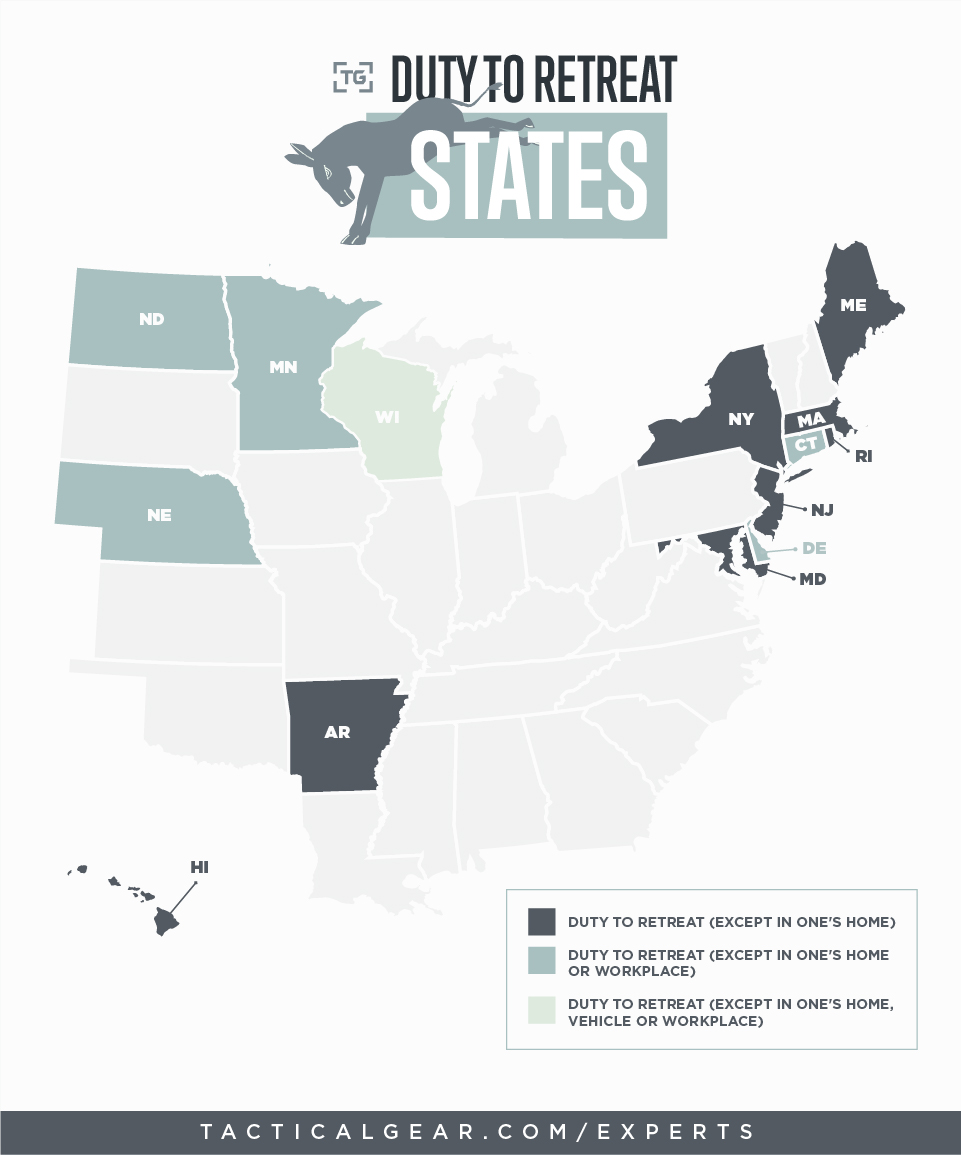
In some states, you must attempt to flee (if feasible) before resorting to lethal force (see our review of all 50 states' Stand-your-ground and duty to retreat laws for more in-depth information). These are called “duty to retreat” states, and some have more strict rules than others.
Duty to Retreat Except in One's Home
In Arkansas, Hawaii, Maine, Maryland, Massachusetts, Minnesota, New Jersey, New York and Rhode Island, the only time you're allowed to use lethal force (without first attempting to retreat) is within your own home. This is also known as the Castle Doctrine.
Duty to Retreat Except in One's Home or Workplace
Connecticut, Delaware, Nebraska and North Dakota allow its residents to use lethal force to defend themselves without first attempting to retreat in both their home and⁄or their workplace, thus expanding a bit on the range of the Castle Doctrine.
Duty to Retreat Except in One's Home, Vehicle or Workplace
Of all the duty-to-retreat states, only Wisconsin allows its citizens to defend themselves in their home, vehicle and workplace without first attempting to retreat. Wisconsin has the least restrictive self-defense laws of any state that doesn't implement any Stand-your-ground laws.
Retaining a Lawyer

You may think that you don't need a defense lawyer until after you're involved in a shooting, but that's the wrong time to start conducting interviews. Most attorneys will grant you a short, free interview to gauge if your needs and budget mesh well with their experience and rates. They will expect a retainer (likely a hefty one) before providing any legal services, but you'll want their business card in your wallet long before you need them.
Of course, five-star lawyers are never cheap, but expert legal representation is not something you'll want to skimp on when your freedom is on the line. Self-defense cases are often legally complex, and an attorney who doesn't specialize in them is less likely to be able to successfully defend you. It's better to be free and in debt than in jail with no debt.
Navigating the Aftermath of a Shooting
Anytime you draw your firearm in self-defense — whether you fire it or not — there are some very specific procedures you'll want to follow once the incident is resolved. Failure to adhere to these guidelines could complicate or even jeopardize your case.
- Relax and compose yourself before you call 911. Don't talk about the details of the crime, the shooting, or anyone's motives on the phone, simply report that there's been a self-defense shooting and that you need police and medical personnel right away. Inform the dispatcher that you are a legally armed citizen, that you will disarm yourself before the police arrive, and that you will cooperate with them fully.
- Don't leave the scene or touch anything that could be considered evidence.
- Secure your firearm before police arrive. Don't approach them or invite them in while you're holding or wearing a weapon. Keep your hands empty and in plain view. If officers can't see you, loudly and clearly announce yourself before coming into their field of view. Tell the officers that you are the homeowner or legally armed citizen and that you are now unarmed and ready to cooperate.
- Don't be surprised if you're initially treated with suspicion or even forcefully detained. Police don't know what they're walking into and may handcuff you for their own safety. Don't take it personally or resist. This is not the time to argue your case. You'll get a chance to lay out the facts in court.
- Don't say anything to the police about the details of the shooting without a lawyer present. Police may pressure you to make a statement before your attorney arrives; resist the temptation and exercise your right to remain silent. Cooperate fully in all other respects.
Navigating the legal system after using your firearm in self defense is a complicated and scary process, but fortunately, you don't need to be a lawyer — you just need to have one, and to follow a few simple guidelines when dealing with the police.