

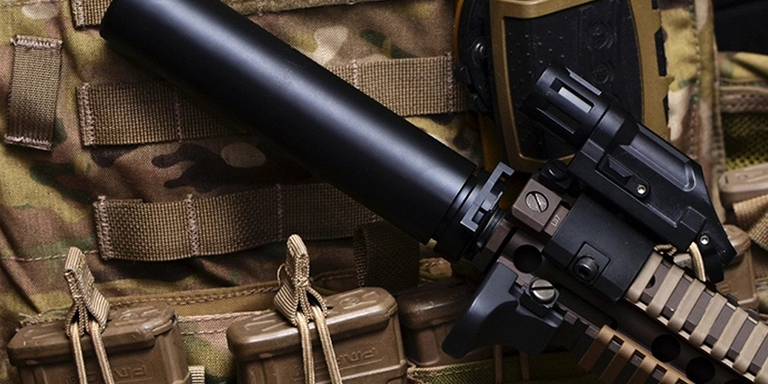
In the right situations, a suppressor is an excellent firearm accessory. Whether you're a hunter or a military service member, these simple yet ingenious attachments work to dissipate noise to help you keep your cover. But suppressors are a complex topic, and laws governing their purchase differ wildly across the country.
In this guide, we'll tackle everything you need to about buying and using a suppressor. We cover what suppressors are and how they work, the history of suppressors, how to deal with regulations and paperwork when purchasing a suppressor, and much more.
What Are Suppressors and How do They Work?
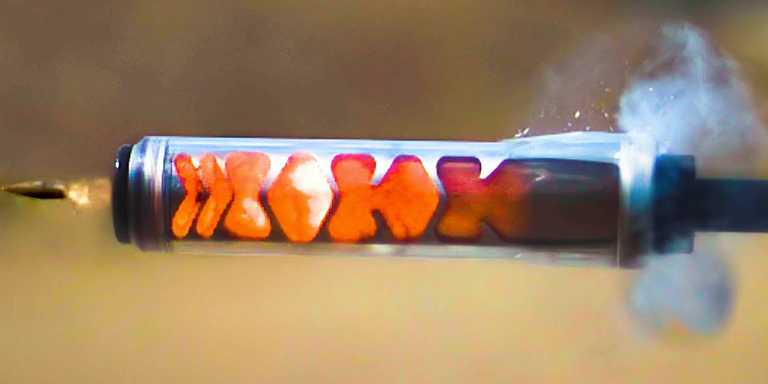
A suppressor is a metal device attached to the front of a firearm's barrel to reduce the level of noise when a gun is fired. The term "silencer" is a common (but misleading) name for a suppressor; even the best suppressor does not come close to silencing a firearm when discharged.
When the trigger of a firearm is pulled, the hammer strike generates a spark inside the cartridge. This ignites gunpowder, causing rapidly expanding hot gasses to force the bullet out of the weapon's barrel. The suppressor is fitted to the end of the barrel to catch, slow down and cool the escaping gasses. However, the suppressor only serves to reduce the noise associated with the rapidly escaping gasses (referred to as the muzzle blast). No suppressor can abate the supersonic noise made by a bullet breaking the speed of sound.
History of Suppressors/Silencers
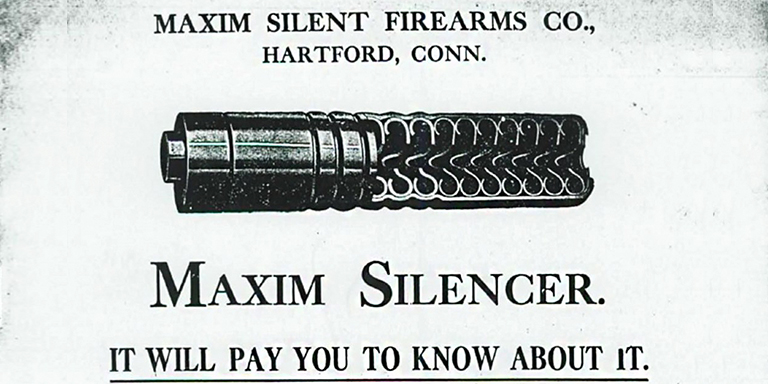
In a sense, suppressors can be thought of as mufflers for guns. This may seem a bit simplistic, but the idea for a silencer came from Hiram Maxim, who is also credited with helping to develop early mufflers for internal combustion engines during the same time period. He invented and produced the first commercially available firearm silencer around 1902 and had his invention patented in 1909, trademarked as the Maxim Silencer.
The Maxim Silencer was quite popular, and customers could purchase it in many popular rifle calibers. It was advertised in magazines and could be bought by mail order. It was designed to be added to the end of a rifle's barrel, and it contained baffles that helped cool expelled gasses, allowing them to expand before leaving the silencer. Even Teddy Roosevelt owned and used a Maxim Silencer on his Winchester 1894 carbine. He claimed it was good for early morning shoots so that he wouldn't awaken the neighbors.
Then came the National Firearms Act of 1934 (NFA), a response to escalating organized gang violence. It placed restrictions on the gangster's guns of choice, namely sawed-off shotguns and machine guns. Silencers were included under the NFA almost as an afterthought as a result of game wardens' complaints that poachers were using suppressors to kill ranchers' livestock for food during the height of the Depression. The inclusion of silencers in this federal legislation has baffled all but the poorly informed for many years.
In 1934, a person could buy a new machine gun for about two hundred dollars, so that was the price Congress decided on for the NFA tax stamp, effectively doubling the cost of these weapons. Legislators believed that doubling the cost would lead to fewer guns being manufactured and purchased. The only good news is that the tax has remained the same for eighty-eight years.
Types of Suppressors
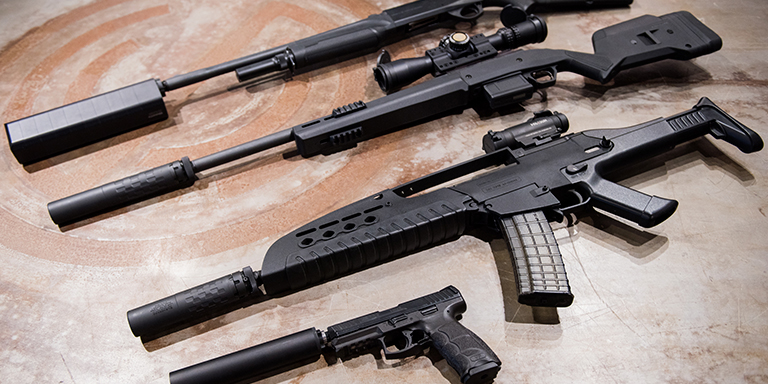
Suppressors are categorized by the kind of weapon they are designed to suppress. The three main categories include handguns, rimfire rifles and centerfire rifles. There are suppressors available for use on shotguns, but these suppressors may typically end up costing more than the shotgun itself. They often demand prices well over $1,000.
Each suppressor type is manufactured to handle the pressure of the escaping gasses from a particular weapon to optimize the suppressor's performance. Suppressors are screwed into the front of the barrel and contain a series of baffles or chambers to slow and cool escaping gasses.
A rimfire suppressor, usually twenty-two caliber, is designed to handle this type of rifle's lower pressure and power. These suppressors tend to be smaller and lighter as they do not have to withstand the higher pressure of centerfire cartridges.
The centerfire suppressor, on the other hand, is engineered to handle much higher pressures from the escaping gasses. As a result, they're manufactured with more substantial materials (such as stainless steel) and are a bit heavier.
Handgun suppressors are a unique case. Semi automatics rely on the gun's recoil to cycle the weapon properly, and suppressors tend to lessen this recoil as gasses exiting the weapon leave at a slower speed. An extra booster or a spring-operated piston device is utilized to combat this reduced recoil, allowing the weapon to continue cycling properly. These devices capture and return some of the recoil force before the suppressor's baffles slow the expelled gasses too much. This return of the recoil force is sufficient to cause the gun's slide to cycle fully.
Myths about Suppressors

The biggest misconception surrounding handgun suppressors is that they make a gun almost completely silent. This myth is perpetuated in most gangster and thriller movies involving hitmen and close-quarter assassinations. In the movies, the hitman raises their semi automatic with an attached silencer, and all that the audience hears is a quiet ping noise of the gun's action cycling and perhaps a thud as each bullet hits the victim.
As is typical with many subjects, though, the realities of suppressors differ from what you see in the movies. A non-suppressed 9mm handgun fired through a Glock 19 generates about 165 decibels of sound, equivalent to standing near a jet engine. Adding a suppressor reduces the noise by about 31 decibels, down to about 134 decibels. In comparison, a jackhammer striking concrete generates around 110 decibels of noise. That's a long way from the soft pings and thuds in the movies.
Banning a Product without the Facts
This unrealistic movie mentality regarding suppressors has convinced state legislators in eight states to ban them from use entirely. It's worth noting that the use of suppressors during the commission of crimes is minuscule — only about fifteen cases a year are prosecuted nationwide.
Inner cities feature gunshot sensors installed at various high-crime locations. The censors can notify police and pinpoint the location of criminal activity through triangulation of the discharge of a firearm. A suppressed handgun is still loud enough to trigger these sensors. Also, the use of a suppressor almost doubles the size of a pistol, making it much harder to conceal. Finally, there is a mandatory federal thirty-year prison sentence imposed for using a suppressor while committing a crime. This thirty-year sentence acts as an enormous deterrent to criminals.
Only Hawaii, California, Illinois, New York, New Jersey, Delaware, Rhode Island and Massachusetts ban suppressors. It's legal to possess a suppressor in the other forty-two states, provided all the correct federal paperwork is filed and approved, and individual state laws are followed.
Why are Suppressors Used?
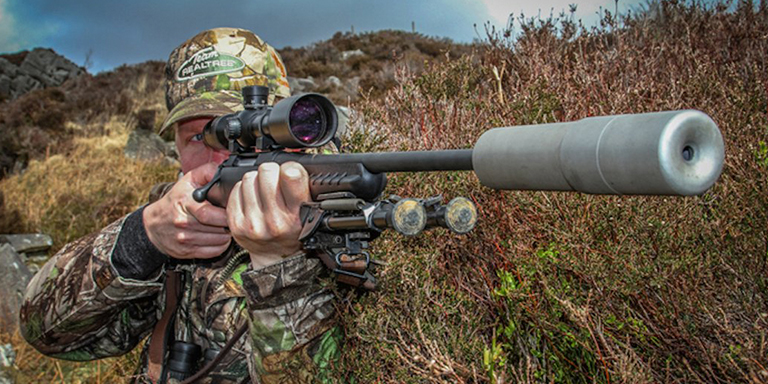
Gun control advocates often ask: why do you need a suppressor at all? Well, hearing protection is the main reason. Imagine going hunting for deer or other game in a thickly wooded area using a centerfire rifle. In this situation, a hunter must be able to listen to what is going on around them. They may hear their intended prey, or detect other hunters in the distance. These other hunters may come into the shooter's line of fire if undetected.
Because hunters need to hear all these minute sounds while they hunt for the sake of their own safety and the safety of other hunters, most don't wear hearing protection. But guns are unforgivably loud, and using one without hearing protection can cause hearing damage. One solution is to use a suppressor, as it lowers the probability of hearing loss from the rifle's muzzle blast. Remember, suppressors don't eliminate the sound completely; they simply reduce it by thirty to forty decibels, just enough to prevent permanent damage to a hunter's ears.
How to Buy a Suppressor
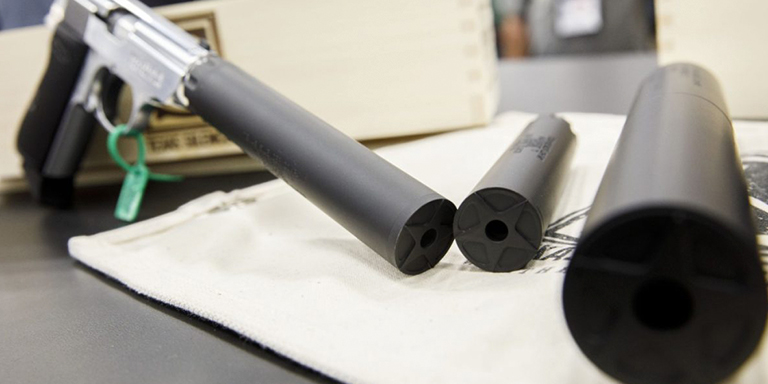
Given the restrictive federal laws, buying a suppressor can be extremely difficult or downright impossible. If you're interested in owning one, though, start with these seven criteria to find out whether or not you'd even be eligible to purchase a suppressor:
If you reside in Hawaii, California, Illinois, New York, New Jersey, Delaware, Rhode Island or Massachusetts, stop here — you cannot even apply to buy a suppressor
You must be a legal resident of the United States
You must be eligible to purchase a firearm in your state
You must be at least twenty-one years of age as an individual applicant
You must purchase the suppressor from a licensed suppressor dealer
You must pay a two-hundred dollar federal transfer tax fee
You must submit ATF Form 4 and pass a Bureau of Alcohol, Tobacco, Firearms and Explosives (BATFE) check (expect a significant wait time)
Navigating the Paperwork
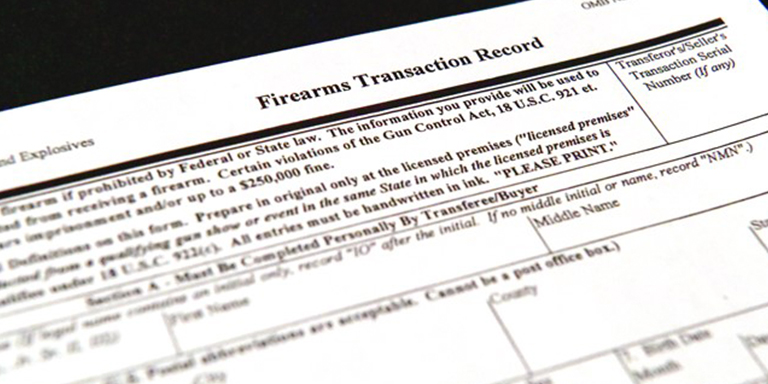
Before you even begin, verify that you meet all of the above criteria. Also, understand that a background investigation will be done and that certain issues such as a criminal record, mental hospital confinement, substance addiction or more could disqualify you.
The first step in making your purchase is to select a suppressor either at a gun shop or from an online retailer. Either type of dealer should be able to assist you in filing the infamous ATF Form 5320.4, better known as ATF Form 4. Parts of the form must be completed by the purchaser, and other sections by the federally licensed seller.
You have the choice of filing Form 4 electronically or submitting a paper version of it. It may not seem that important, but electronic vs. paper filing is a critical choice. Until recently, a paper Form 4 was the only way to go, but the wait times were legendary and measured in months rather than days. Then came eForm 4, which is entirely digital and is linked to already existing firearms records and the seller's registered inventory.
An applicant must complete every field of this multi-page form, or the program will return the applicant to the highlighted area that's missing information. It is, however, possible to submit an incorrect entry using this system, and that's a problem. When using a paper Form 4, if an error is made, the application is simply sent back to the applicant for correction. When using eForm 4, though, any mistake in the application results in the rejection of the entire application. The applicant must then start the entire process all over again.
On the positive side, according to NFATracker (at least at the time of writing), a paper Form 4 for an individual is still averaging 254 days from application to approval and another thirteen days to receive the tax stamp. However, the newer eForm 4 is averaging just 46 days for approval (provided the application is submitted perfectly). Also, the tax stamp is issued electronically on the same day, circumventing the additional waiting period to receive the stamp. Doing the math, at this point an applicant could make an error on eForm 4 and have to start over three times before getting it right, and it would still be quicker than the old paper form.
The key to your purchase is to work with an established suppressor dealer. These professionals do hundreds of successful transactions a year and can guide you through the application process with as little pain and frustration as possible. Many stores that sell suppressors have kiosks set up for uploading fingerprints, photographs and electronic completion of eForm 4. If a dealer isn't able to walk you through the process, you should find another dealer. Remember — a suppressor dealer only makes money when the applicant is approved and the sale goes through.
Consider the benefits of owning a suppressor. It's true that they aren't cheap, and the government will want their $200 tax stamp while subjecting you to an arduous process of filling out complicated paperwork. But preserving your hearing while enjoying hunting or target shooting is undoubtedly worth the price of protection and the headache that the suppressor purchasing process can lead to.