

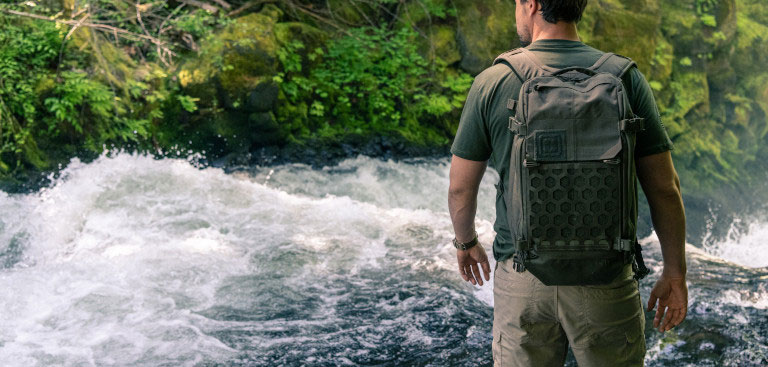
In most countries that conduct official studies on drowning deaths, more people drown in rivers, creeks and streams than in any other body of water. It's hard to determine how many people die trying to cross them, but it's undoubtedly a significant percentage; currents, in particular, can be deceptively strong and claim lives on a regular basis.
This guide will review safety tips and strategies for crossing running rivers and streams (if you must).
Find the Best Place to Cross
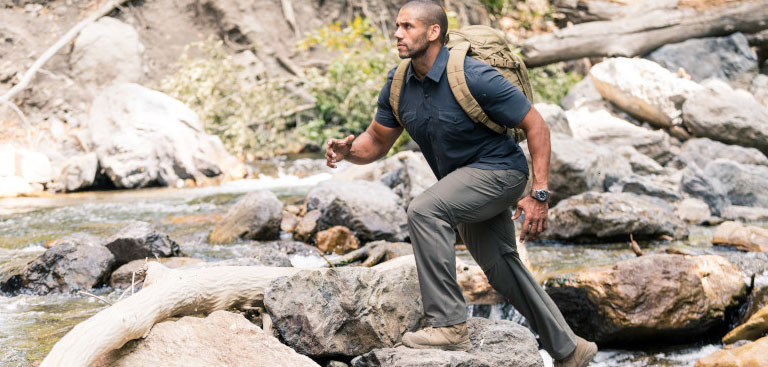
When you come to a river while spending time in the great outdoors, the safest course of action is to avoid crossing it unless there's a well-maintained bridge. Cross fast-running rivers only if you have a dire need and only if you can find a relatively safe place to do so.
Check the speed of the current by throwing a stick into the water and walking downstream alongside it. If the stick travels faster than a brisk walking pace, the current is too strong to cross safely. Ford fast-moving rivers only in true life-or-death emergencies and only after making adequate preparations first.
Try to find a crossing spot with as many of the following characteristics as possible:
- If the river bends, cross at a straight section. This will provide the shortest and most manageable path and will minimize the time you spend in the water.
- Look for the shallowest stretch of water, ideally no higher than your knees. In general, wider sections of the river will have calmer currents. The stronger the current, the shallower the water must be in order to cross safely. Use a long stick or branch to check the water's depth and keep it to use for balance later.
- Watch the river for a while to see how often debris floats downstream. If logs or branches come by regularly, make sure you have unobstructed visibility far enough upriver to see them coming well in advance.
- Look for islands, sandbars, or other relatively safe places to stop and rest partway across.
- Cross rivers fed by glacial runoff early in the morning. As temperatures rise later in the day, ice melts rapidly and the river can get deeper with alarming speed. The current will also get much stronger. Rivers fed by melting ice can be extraordinarily dangerous.
Pre-Crossing Preparations
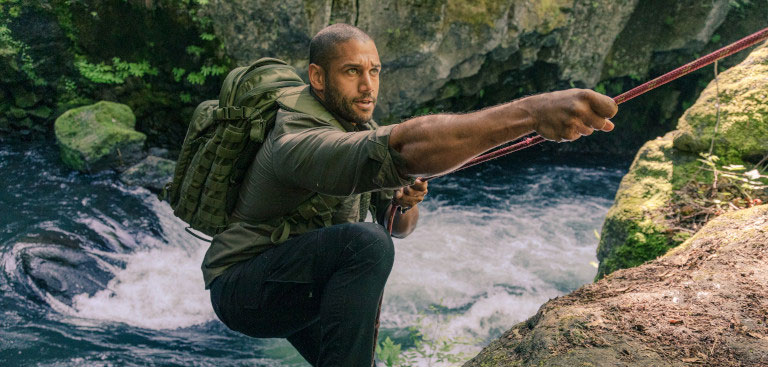
If you have rope, secure one end to a tree or large rock with a non-slip knot to create a lifeline. Make sure the anchor you choose is unquestionably heavy and sturdy enough to hold you and your gear fast against the current. Pull on the rope as hard as you can to test the knot's strength.
Find or cut a sturdy branch to use as a walking stick as you cross. You'll use it to carefully probe the river floor ahead of you, but it also needs to be strong enough to support your full weight if you need it to brace yourself against the current.
Change into spare boots or shoes if you have some. If you don't, remove your socks but keep your shoes on. Don't cross the river barefoot; there are likely sharp rocks, crevices, and other hazards on the bottom that your footwear can protect you from.
Paradoxically, the colder it is outside, the more of your clothing you need to remove before you cross the river. As long as you're dry, you can be lightly clothed for a few minutes at a time, even in near-blizzard conditions, with no long-lasting ill effects. But if your clothes get wet and it's below about 60°F/16°C, hypothermia will set in quickly and could eventually prove fatal.
Wet clothing also becomes more dangerous the stronger the current is. As your clothes become increasingly waterlogged, they get heavier — a lot heavier. The extra weight can easily throw you off balance and make it harder to keep your head above water if you fall.
Before stepping into the water, loosen your backpack, belt and anything else that's attached to your body with straps, buttons or zippers. Should you fall and get carried away by the current, your gear could easily get snagged on branches or rocks. If that happens while your head is underwater, you'll be in real trouble. Loosening your gear makes it easier to slip out of it if you need to. Losing a backpack full of valuable equipment is bad, but drowning is a lot worse. The only thing that should be tightly secured to your body is your lifeline.
Crossing Safely Alone or with Others
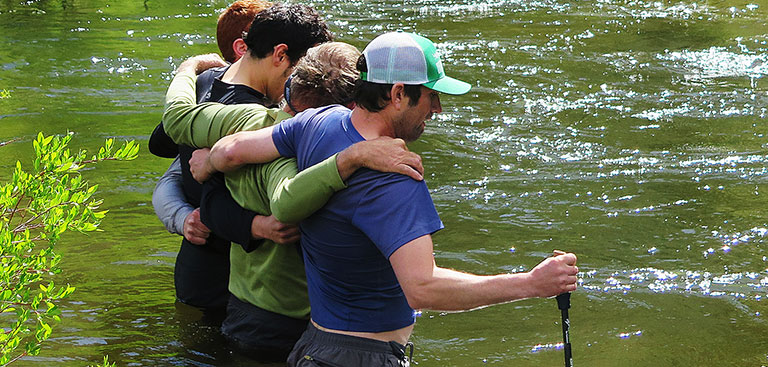
While crossing, keep two points of contact with the river bottom at all times (your walking stick being the third possible point of contact). Brace the stick against the bottom at a 45-degree angle downstream from your body and be prepared to lean on it for support if the current suddenly pushes you in that direction.
Walk slowly and diagonally against the direction of the current. Take the shortest path to the opposite bank and keep your eyes peeled upstream for debris that might hit you. Stay calm and don't rush. Moving against a strong current can tire you out quickly, so take it easy and conserve your stamina.
While crossing, if your gut tells you that this is a bad idea, listen to it. Retrace your steps back to shore unless proceeding to the opposite shore is now the shorter and safer path. Even if you have to walk for hours to find a safer place to cross, that's better than pushing your luck.
If you're crossing with others, hold onto one another and have the strongest or heaviest person lead the way. Don't tie or otherwise secure yourselves to one another. Everyone should have their own separate lifeline so that one person doesn't drag everyone else along if they get swept away. Take care to ensure that the lifelines don't get tangled.
When you reach the opposite bank, consider whether you can afford to leave your rope behind. If not, rest and warm up for a few minutes, then find another anchor point on this side of the river to tie the lifeline to. You can then cross the river again using the rope for support, untie the original knot, tie that end around yourself to make a new lifeline, and then cross once more. Of course, crossing a river three times is three times riskier than doing it once, so take that risk only if you really need the rope. If you have other people with you, send the strongest and heaviest person back across to retrieve the lifelines.
Emergency Water Rescue
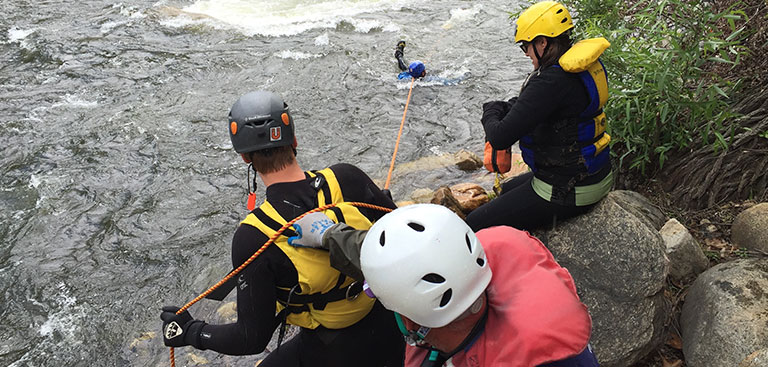
To be clear, water rescue by trained emergency personnel is something entirely separate from techniques used to save yourself or others in the middle of nowhere. These techniques are likely to be effective only in mildly to moderately dangerous waters. Never try to cross swift water (white rapids) on foot under any circumstances.
If you fall down and get carried away by the current, take a deep breath, do your best to keep your head above the water, and use both hands to pull yourself back to shore along your lifeline.
Should you lose your lifeline or not have one, immediately ditch your backpack and anything else that could drag you under the surface or get caught on obstacles. Swim toward the nearest bank perpendicular to the current at a slow and controlled pace. If the current is strong, it may seem like you're not making any progress, but you are. Conserve your stamina, don't panic, control your breathing, and keep swimming slowly. Never try to fight the current — you'll become exhausted in a matter of seconds.
Glance downstream every few seconds and watch for dangerous obstacles. If the current is going to carry you into one and you can't avoid it, take a deep breath, curl into a ball and cover your head with your arms. Keep your muscles relaxed and try not to inhale or exhale when you hit the object. Once you're carried past it, resume swimming and remember to stay calm.
Crossing rivers and streams can be a nerve-racking and risky endeavor, but as long as you accurately assess the danger, err on the side of caution and use proper techniques, you should be okay. Never forget the first and best strategy for crossing a fast-flowing river: If possible, don't.