

Within the U.S., each state has different gun laws, and you need to know what they are before passing through that state. Ignorance of the law is not a legal defense for violating it, and state-level gun laws are no exception. This guide will offer some general guidance for making sure you stay in compliance when you travel with your firearms.
Disclaimer: We did plenty of research and we have lots of experience traveling with guns, but we can't give fully up-to-date guidance on every state's laws. This information is general and may not be fully correct in every state, and laws can change at any time. Be sure to do state-specific research before traveling with a weapon.
Can I Travel Internationally with a Gun?
In most cases, the answer to this question is a firm "no." The vast majority of other countries have gun laws far more restrictive than America's, and in most of those places, foreigners aren't allowed to be armed at all. In the rare event that you'll be traveling to a country that allows visitors to bring weapons, you'll need to contact that country's law enforcement agency for guidance.
Carrying a Gun vs. Transporting a Gun
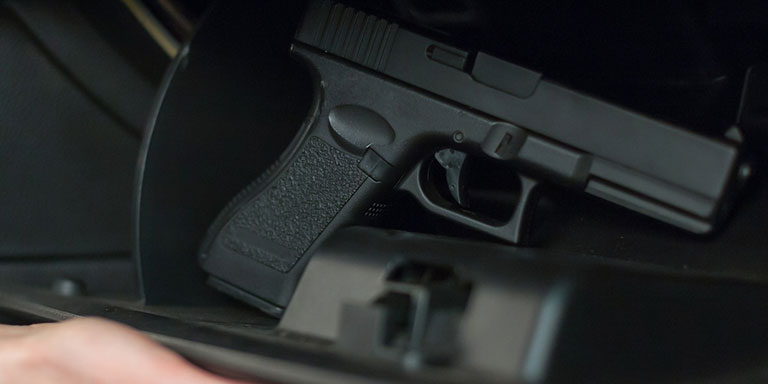
It may sound like semantics, but legally, carrying a gun and transporting one are slightly different things. If it's illegal to carry a gun on your person in a state you'll be traveling to, don't give up just yet — if all else fails, it is legal to transport an unloaded gun in a vehicle or luggage as long as it's stored properly and not readily accessible.
The Firearm Owners' Protection Act (FOPA) is a federal law that protects your right to transport any firearm you can legally own in both the origin and destination states even if you'll be traveling through states in which the firearm is illegal. However, the existence of FOPA doesn't guarantee a smooth and easy experience, should local law enforcement in a gun-restrictive state take issue with your possession of a firearm.
For one thing, not all law enforcement personnel even know that FOPA exists. If you're traveling through a state in which your firearms are illegal or heavily restricted, you'll want to be prepared with thorough documentation. Print out several copies of the FOPA statute itself, as well as any firearm-related licenses or permits you have and your travel itinerary.
Most reasonable law enforcement officers will let you go on your way when you explain your rights under FOPA, but there's never a guarantee that anyone will be reasonable. Be aware that some states treat FOPA as an "affirmative defense," which means that citing it may not prevent your arrest but it is recognized as a valid defense in court.
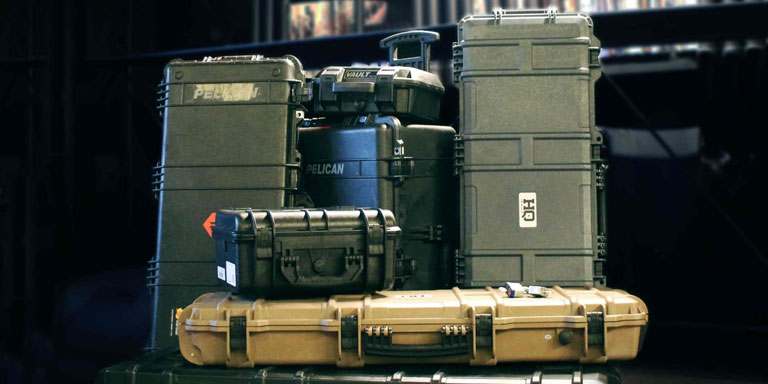
Know that in order to be protected under FOPA, you'll need to store your firearms and ammunition in separate containers in the trunk, cargo area or otherwise not easily accessible to any of the vehicle's passengers while it's in motion. Your firearms must also be unloaded and stored in locked containers. If your vehicle doesn't have a separate trunk or cargo area, you'll need to store the firearms wherever they are least accessible to the vehicle's passengers.
Finally, be aware that FOPA only overrides state law in states that you're merely "passing through," meaning your travel through that state must be "continuous and uninterrupted." You may be asking exactly what that means, but you're out of luck — the law doesn't get any more specific. Presumably, you're allowed to stop for gas, food or a good night's sleep, but no court has yet made a ruling about the exact meaning of "continuous and uninterrupted." It's probably best to pass through firearm-unfriendly states as quickly as you (safely) can.
Concealed Weapon Reciprocity
As soon as your firearm is loaded, carried on your person or stored in an easily accessible place in your luggage or vehicle, FOPA no longer applies and the laws of the state you're in will take precedence. If you have a current and valid CCW (concealed carried weapon permit) in your state of residence, check a CCW reciprocity map to see if the states you're traveling through have agreements with yours to honor its CCW permits. Note that these maps are usually maintained and updated by volunteers or private companies, so they may not be fully accurate. Always contact the local police or sheriff's department to confirm that your permit is valid in that area.
Once you reach your destination state, FOPA ceases to apply and you'll need to comply with that state's laws regarding the transportation and carrying of firearms.
Flying with Guns
Many people assume that you can't bring a gun onto a plane under any circumstances. You actually can, provided you follow a strict set of TSA procedures (more on those in a moment).
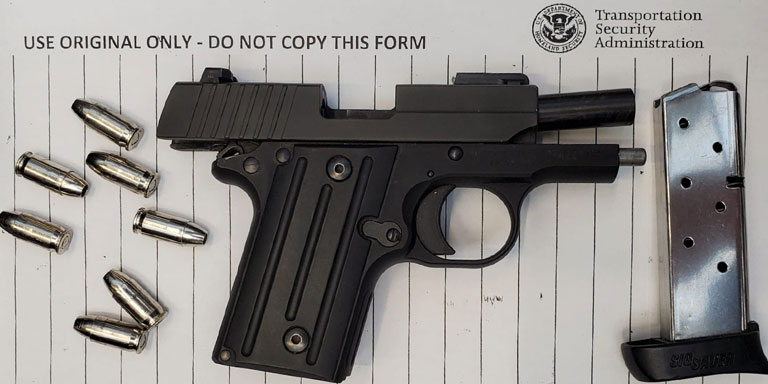
First and foremost, double-check all of your bags, especially your carry-on bags. If you've inadvertently left ammunition, magazines or other firearm components in any of your bags, you could be held for extensive security screening or even charged with a crime. Ensure that you know exactly what you're bringing to the airport and that all firearms and ammunition are in checked bags only.
Many people who do know that it's possible to fly with your gun assume that the TSA knows each state's gun laws and will stop you from doing something illegal, but this is not the case. The TSA only complies with general federal firearm laws and doesn't know or care about the laws in the states you're traveling to. FOPA does apply to airplane travel, but again, many TSA employees don't know that FOPA exists. We strongly recommend placing printed copies of the FOPA statute inside each container that holds firearms or ammunition.
TSA Firearm Regulations
The TSA requires all firearms to be in checked baggage or checked separately. Under no circumstances can you bring a firearm into the passenger compartment of a commercial plane; only Sky Marshals and on-duty law enforcement personnel are exempt.
Handguns must be unloaded and stored in a locked, hard-sided container inside your checked baggage. Long guns must be stored in locked, hard-sided containers and checked separately. You may store multiple guns in the same case as long as they don't prevent the case from closing fully. For both handguns and long guns, the lock must either be integrated into the case or it must completely prevent the case from being opened (once upon a time, you could get away with wrapping a cable lock around the case's handle, but this generally doesn't fly anymore).
Ammunition must be stored in a separate container in your checked baggage (the original box is acceptable). Loaded magazines are not allowed. Each airline imposes different limits on how much ammunition you're allowed to bring, so you'll need to contact the airline or visit its website to check. Generally, you can bring one or two boxes, but the limit is based on weight, not number of rounds.
Before you head to the airport, take photographs of all firearms you're flying with and make sure the serial numbers are clearly visible. Place cards with your name, address, and phone number inside each gun case. These steps will help prove ownership if your guns are lost or stolen in transit. If a gun is particularly valuable, you may want to insure it through a third party; the airline's default lost luggage payout may not cover its full value.
Allow at least an extra thirty minutes to check your firearm (or longer when the airport is busy). When you get to the airport, head to the check-in counter and let the airline employee know that you have a firearm. They'll give you a firearm declaration card, on which you must list your name, address, phone number and destination. The employee will place the card in your bag and finish checking you in, then direct you to a special screening area where a TSA employee will check your luggage and verify that the gun is stored correctly. You must wait in this area until a TSA employee tells you that you can proceed to your gate.
Bring extra locks and keys, and/or a spare, empty firearm case that meets TSA requirements. The TSA may cut or force open the case during later inspections, and if you can't re-package it to their satisfaction, you could be held at the airport and may miss your flight.
At this point, you should be done, but keep an ear out for the airport's paging system. You may be paged if a TSA employee discovers a problem.
Airline-Specific Firearm Policies
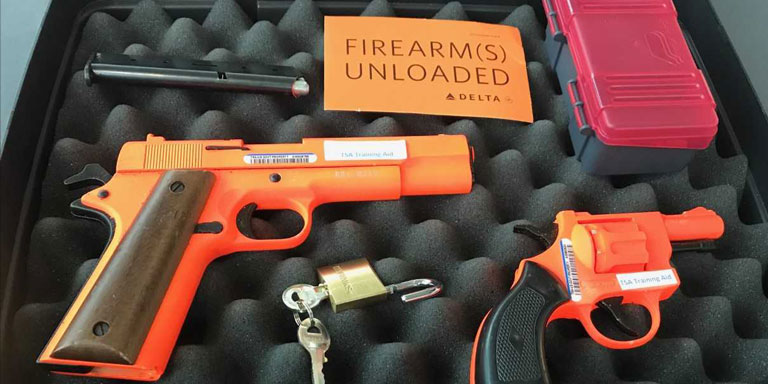
All domestic airlines follow TSA regulations on the transportation of firearms, but some impose additional restrictions. These restrictions aren't laws, but they are airline policies, and the airline can cancel your ticket if you don't abide by them.
For the most part, these additional restrictions are minor. To avoid unwelcome surprises, contact the airline before your trip and ask whether there are any rules other than TSA regulations that you need to be aware of.
If you're flying to another country in which you're legally allowed to possess a firearm, know that only certain airlines allow you to check firearms on international flights. Each such airline has its own policies, so make sure you understand them well in advance of your trip. Also ensure that you obtain and fill out all required customs forms for both your departure and return trips.
Special Considerations in Certain States
In recent years, airport authorities in New York and New Jersey have been known to seize firearms and even arrest passengers who are fully in compliance with FOPA. The act has been repeatedly challenged in New York and New Jersey courts, and some law enforcement officials in those states insist on ignoring it. If you're flying through either state, you may want to consider shipping your firearms to your final destination.
California, Hawaii, Massachusetts, and Washington D.C. also have especially complex and restrictive laws regarding the transportation of firearms. Contact a local attorney or police department for guidance if you plan to travel through any of these places.
Staying within the law while traveling with firearms can be a pain, but the alternative is a lot worse. An hour or two of careful research before you depart can save you major headaches — even fines or jail time — later on. If you have a particularly unusual travel situation, or if you're just unclear about the law, don't hesitate to get additional legal counsel.