

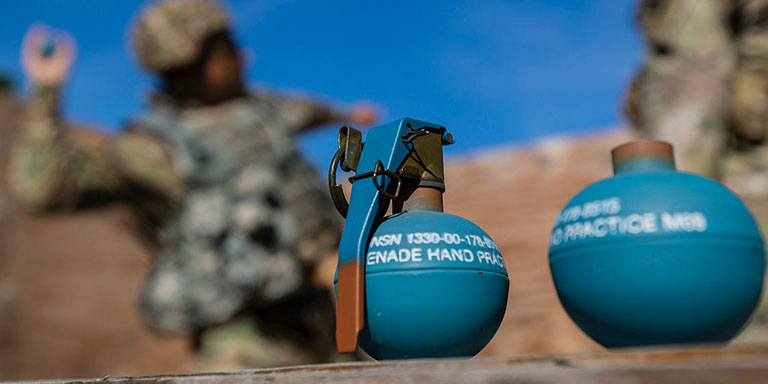
You'll get to throw at least one live grenade during your military career; that time will come during Basic Training. After that, though, it's mostly combat and explosives specialists who get to keep training with heavy ordnance.
Nonetheless, grenades are things that you really don't want to make mistakes with, so you should have a basic understanding of how to handle them safely if you ever need to. In this guide, we'll review the basic anatomy of grenades, as well as where, when and how to use them (and when not to).
Grenade Anatomy
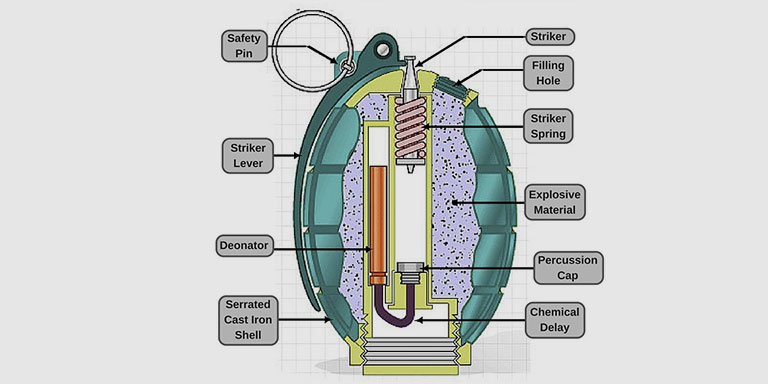
Hand grenades have seven or eight basic parts: a casing, a fuse, a detonator, a safety pin, a striker lever (or "spoon"), a striker, a percussion cap, and (in some cases) fragmentation material or some other kind of extra payload.
- The casing is the body of the grenade that houses most of the other components. In some models, the case itself is designed to fragment in such a way as to cause additional injuries upon exploding.
- The safety pin holds the striker lever in place and prevents accidental detonation.
- The striker lever holds the striker in place and acts as a secondary safety mechanism.
- The striker, when no longer restrained by the striker lever, impacts the percussion cap.
- The percussion cap ignites the fuse when struck by the striker.
- The fuse is ignited by the percussion cap and, in turn, ignites the detonator. Most grenade fuses burn for approximately four seconds, but this is never an exact timeframe.
- The detonator causes a powerful explosion, usually with an effective radius (i.e., "kill zone") ranging from 5 to 15 meters.
- The extra payload (if any) is deployed concurrently with the primary explosion.
These parts and their exact functions may vary somewhat across different grenades, especially those used in countries outside the U.S. Training grenades are inert grenade bodies that contain no explosive material. Alternatively, they may contain an amount of low-yield explosive material equivalent to a small firecracker. Before handling live grenades, practice with training grenades until you can handle them safely, confidently and comfortably.
Handling and Throwing Grenades
First and foremost: Never handle any grenade unless you've been trained on its use and cleared to do so. Even then, don't open the storage container until you're ready to use the grenades. Never make unauthorized modifications or store grenades inappropriately, such as by attaching them to your vest by the safety pin in an effort to make them more quickly accessible. Always wear hearing protection when training with live grenades.
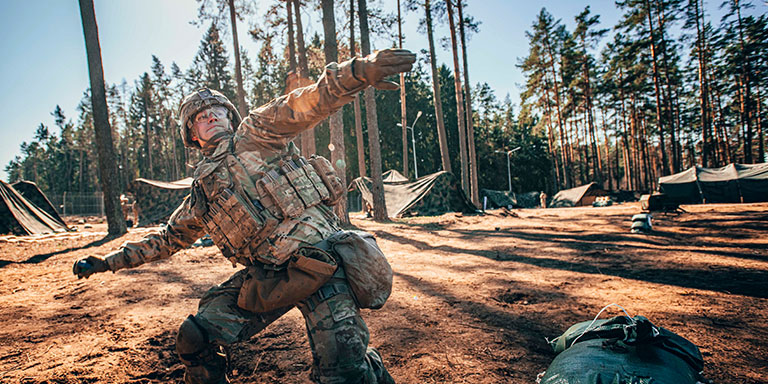
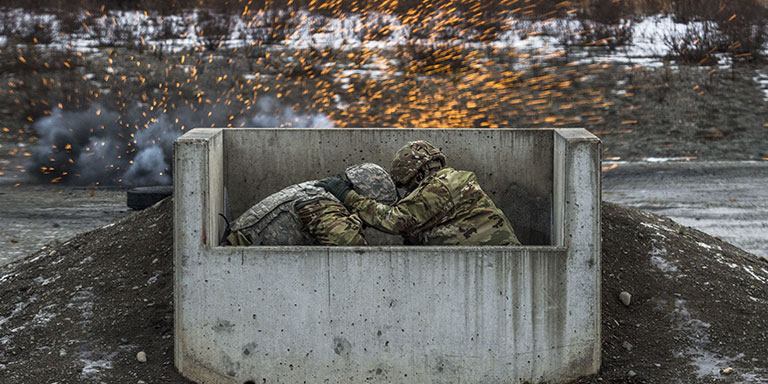
Once you're properly and safely positioned (in training environments, this means you're in a concrete bunker), hold the grenade firmly in your dominant hand with the spoon pressed tight against your palm. Carefully consider the grenade's flight path and take care to avoid any objects or obstacles that could cause it to bounce or roll back toward you, or toward your allies or equipment.
Remove the safety pin with your non-dominant hand while keeping the spoon firmly in contact with the grenade body; the safety pin will not come out otherwise. The spoon is spring-loaded and under heavy tension, so take extreme caution to keep it in place until you're ready to throw. Note that it's possible to replace the safety pin as long as the spoon is still attached, but once you release it, the grenade is live and cannot be disarmed.
Do not attempt to release the spoon before throwing the grenade. Simply throw the grenade without altering your grip on it, and the spoon will detach as soon as the grenade leaves your hand. Immediately take cover as directed by your RSO (Range Safety Officer). Do not leave cover until the grenade detonates. If it doesn't, remain in cover until your RSO or an EOD (Explosive Ordnance Disposal) expert tells you it's safe to come out.
Projectile Grenades
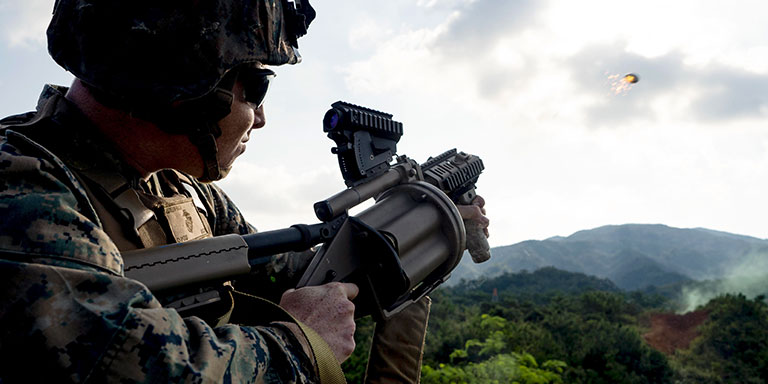
Some grenades are designed to be fired from handheld or vehicle-mounted launchers rather than being thrown. The two most common varieties are the low-velocity 40x46mm grenade used in launchers such as the M203 and M79, and the high-velocity 40x53mm grenade used in crew-served and mounted weapon systems such as the MK19 belt-fed grenade launcher.
Most low-velocity 40mm launchers are either single-shot models or semi-automatic weapons with a rotating cylinder similar to that of a revolver. In both cases, cartridges must be loaded by hand.
For safety reasons, 40mm grenades contain small computer chips that can detect how far the grenade has traveled after being fired; the explosive isn't armed, so it won't detonate until the grenade has traveled a certain distance (usually at least 20 meters). However, if the chip malfunctions or isn't programmed, the grenade will detonate on impact at any range.
Tactical Considerations
Grenades have many battlefield applications, including:
- Engaging multiple enemies at once
- Room clearing
- Flushing enemies out of cover
- Engaging enemies that are difficult or impossible to target with gunfire
- Damaging enemy eyesight or hearing, even if the grenade otherwise causes no injury
- Damaging enemy structures or equipment in a pinch
In general, U.S. military infantrymen carry two hand grenades in combat zones, although there is no official or mandated standard. Some may carry none, whereas grenadiers may carry twenty (usually 40mm) grenades or more. Your operational goals, unit composition, and the availability of grenades in your area will all be relevant factors.
Other Types of Grenades
Fragmentation grenades aren't the only kind. There are many other, more specialized types.
- Incendiary grenades contain explosive and/or flammable compounds designed to ignite or intensify fires.
- Thermite grenades burn at extremely high temperatures — even underwater. They can be used to cut through metal doors, destroy vehicle engines, or otherwise sabotage equipment.
- Concussion grenades (aka flashbangs) are nonlethal grenades that emit bright flashes of light and loud bangs intended to stun and disorient enemies.
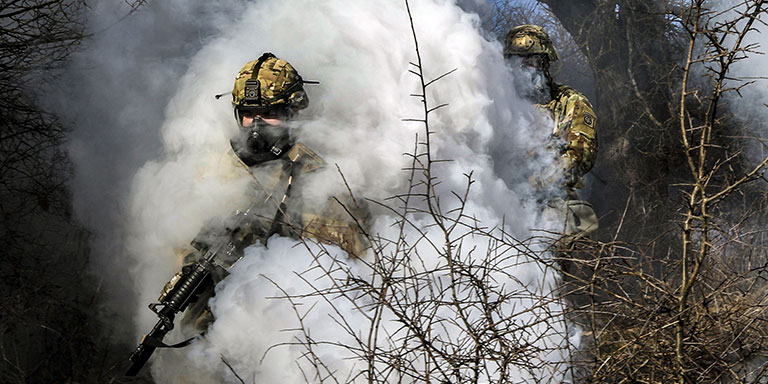
- Smoke grenades emit thick clouds of smoke or vapor and are useful for obscuring enemy visibility.
- Signal grenades are a subtype of smoke grenade that discharge brightly colored smoke clouds that rise into the air as opposed to spreading horizontally. They are commonly used to signal aircraft.
- Illumination grenades emit bright, sustained light and are used like flares or flashlights to light dark areas or hinder enemies' sight.
- Gas grenades can fill an area with lethal or nonlethal gas to subdue enemies. Provided a nonlethal variant is used, they can come in handy in hostage situations wherein it is difficult or impossible to identify or precisely engage enemy targets.
When and How to Use Grenades
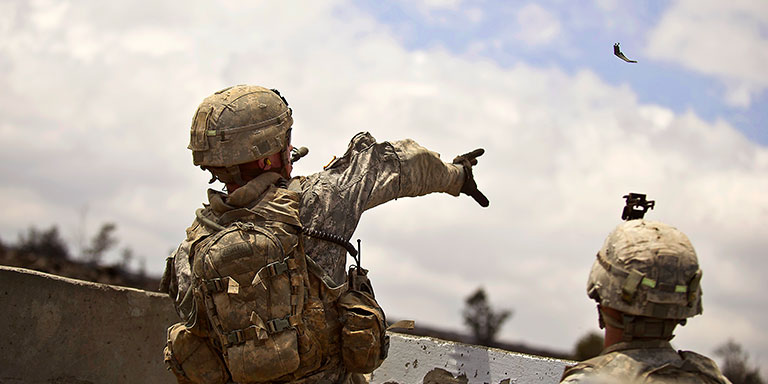
Because grenades are highly destructive and deal damage indiscriminately over a wide area, you must have a clear understanding of when to use them.
In general, grenades are considered a secondary or backup weapon intended for use only when there is no more tactically preferable way to engage a target. One notable exception is room clearing; grenades are often the preferred first-line option because they minimize risk to you and your allies outside the room.
The preferred technique for mitigating the risk of an enemy throwing a live grenade back at you is called a "hard throw," or "hard bounce throw." Suitable only in enclosed areas, this involves throwing the grenade forcefully at a wall, floor or object such that it bounces unpredictably around the room. This makes it difficult for the enemy to catch the grenade (much less throw it back) before it detonates.
If a hard bounce throw is not suitable, roll or place grenades instead of throwing them whenever possible. Even if you can generally throw things accurately, there is always a chance that a thrown grenade will go somewhere other than where you want it to go. Minimize the risk of potentially fatal mistakes by not attempting difficult (or easy) throws if you don't have to. If you must throw, get as close as you can to the target without exposing yourself to additional danger. For instance, if throwing a grenade into a room, try to do so from next to the door or window rather than throwing from across the hall or entryway.
Grenades also come in handy when the target is behind a wall, vehicle, or other object such that it's easier to throw a grenade over it or roll one past it than to shoot around or through it. If the enemy is below you in a building, rolling a grenade down the stairs is an effective tactic.
If you can spare the time, signal nonverbally to your allies that you intend to use a grenade and wait until they can lay down suppressing fire and/or cover you. Remain in cover while you remove the safety pin, but take great care to keep the spoon firmly in place with a proper throwing grip. Lean out of cover when it's relatively safe to do so, just long enough to plan your throw. Return to cover and lean out again only when you're ready to throw. If possible, wait for your allies to signal it's clear (or at least wait for a break in enemy fire) before throwing.
How Not to Use Grenades
Despite their myriad of advantages, grenades can be extremely dangerous to you, your allies or nearby noncombatants if used inappropriately. There are a few circumstances in which you generally don't want to use them — namely, throwing them upstairs. There's a high chance of the grenade bouncing or falling back down the stairs toward you.
You should also never "cook" a grenade — that is, release the spoon and hold it while it's live in an effort to reduce the enemy's ability to throw it back. Grenade fuses are inconsistent and impossible to predict. Many service members have lost limbs or been killed by cooked grenades.
Finally, many people believe that the military teaches servicemembers to jump on live grenades if there is no other way to save one's allies from the blast. This is pure Hollywood fiction; the military does not teach or endorse this, although it does happen on rare occasions. Standard avoidance tactics (moving away from the grenade and taking cover or falling prone) are generally effective; this may increase casualties, but it typically reduces fatalities.
Grenades are varied and highly dangerous, and their associated tactics require regular practice to fully master. A guide like this one can cover only the most basic fundamentals. Still, if you routinely brush up on these fundamentals, you may one day be glad you did.