

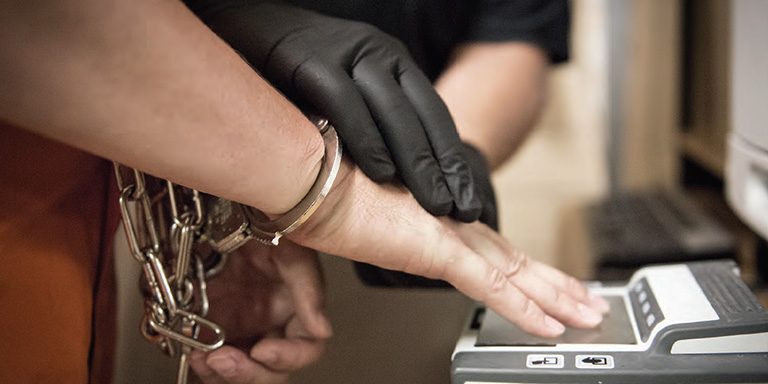
A fingerprint is an impression or mark made by the ridge pattern on a person's fingertips. There are three basic factors that determine fingerprint identification. First, everyone has fingerprints on the tip of each finger. Second, no two people have the same fingerprints, making each person uniquely identifiable; even Identical twins have different fingerprints. Lastly, the ridge detail of fingerprints develops in the womb and will not change during a person's lifetime.
In this guide, we cover everything police officers need to know about using unique fingerprint identifiers in the line of duty. From collecting prints to using them to solve crimes, we go over the basic principles of using fingerprints in police work.
Fingerprint Patterns

While each person's fingerprints are totally unique, it may be surprising to learn that there are only three basic patterns of fingerprints: the arch, the loop and the whorl. Each type has its own subcategories, but every fingerprint fits into one of these three main parent categories.
As far as subcategories go, arch fingerprints can be either a simple arch or tented arch. Loops have two subcategories as well: either an ulna loop or radial loop. Whorls are the most diverse of three main categories. They can be any one of four types: plain, a central pocket loop, a double loop and an accidental loop.
Patent, Latent and Plastic Fingerprints

While there are three distinct fingerprint patterns, there are also three types of fingerprints which may be left behind at a crime scene: patent prints, latent prints and plastic prints. It's important to be able to identify which type you come across to know how to handle, collect and preserve the evidence.
A patent fingerprint is visible to the naked eye. The most common example is that of a bloody fingerprint left at a crime scene.
A latent fingerprint is invisible to the eye. These fingerprints are developed or made visible by one of several field or laboratory techniques, most commonly fingerprint powder.
A plastic fingerprint is three-dimensional, such as when a person presses their fingers into a soft substance that captures the detail of the fingerprint. Some examples of a plastic fingerprint include an impression left in a bar of soap, wet paint or tar. The substance must be malleable enough to make a depression yet firm enough to maintain the print's ridge detail.
Collecting Fingerprints
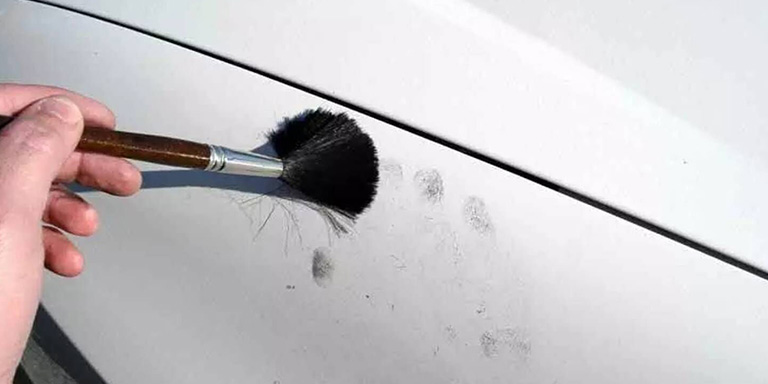
Fingerprints that are already visible (such as patent or plastic prints) need no further visibility development. However, they must be adequately photographed and, if possible, secured.
Latent fingerprints, on the other hand, must be located and developed. The investigator's first job is to determine what areas of the crime scene to process. The entry and exit points are good places to start, as the perpetrator probably touched a door or a window to gain access. Next, look for items that appear out of place, such as overturned furniture or an open dresser draw. Anything that indicates the perpetrator may have touched it should be dusted for prints.
Once a latent fingerprint is identified and visible, it should be carefully photographed before any attempt to lift the print. Lifting a fingerprint must be done using a special, clear fingerprint tape. The investigator should place the tape carefully over the print, taking care not to allow air bubbles to form or the print to smear.
The next step in lifting the print involves carefully peeling the tape away from the surface on which it was left. Fingerprint powder will adhere to the tape, transferring the ridge details of the print from the surface to the tape. The tape is then carefully attached to a plain white fingerprint card. An officer could also use the unlined side of a three-by-five notecard. If an officer is using a notecard, they must record all the necessary information on the card after transferring the fingerprint. The best information to note includes the approximate location of where the print was found, the date, the time the print was taken, the case number and the officer who lifted the print.
The search for fingerprints can be daunting, as locating fingerprints doesn't necessarily mean they belong to a perpetrator. Everyone who touches something may leave fingerprints behind. Dusting a crime scene in a hotel room, for example, may uncover the fingerprints of previous guests, the cleaning staff and even repair workers. If a crime scene takes place at a residence, prints must be taken from all household members as a point of comparison for any other fingerprints found at the scene. Lifting a latent fingerprint can be encouraging, until it's determined that it belongs to one of the residents and not the suspect.
While major crime scenes (such as homicides) are processed by skilled crime scene investigators, a smaller residential burglary may be left to the responding officer to process. This is especially true in smaller, more rural police departments. A well-rounded officer should understand the process of finding, photographing and lifting fingerprints from crime scenes. A small latent fingerprint kit is a welcome addition to an officer's patrol bag.
Partial Fingerprints

Most fingerprints lifted from crime scenes will be partial prints, showing the ridge detail of only a portion of a finger. Part of the print will be missing or, more commonly, smudged with no ridge detail. This is not to say a partial print cannot be used to help identify a perpetrator — even a small section of a fingerprint can be used if a suspect has already been identified.
Matching partial prints is one reason why properly rolled fingerprints are so important. The rolled fingerprint should capture as much of the sides and top of the finger as possible. The more detail captured, the easier it is to match a fingerprint to a suspect.
The Downside of Latent Fingerprints
Latent fingerprints have helped to solve many crimes, but they are not without their downsides. Luckily, a fingerprint placed on a surface will remain there until some outside force removes it or wipes it away. However, lifting a fingerprint from a public location (e.g. the counter of a liquor store) only means that the suspect was in that location and touched that particular surface at some point in time. It can be difficult to pin down an exact timeline without the help of other supporting evidence.
Another downside of latent prints is that it's easy to avoid leaving them. Many criminals avoid leaving fingerprints by wearing gloves or by wiping down any surfaces they may have touched. Unfortunately, the best crime scene technician cannot find prints if none are left.
On the upside, many criminals make mistakes. For example, a burglar may wear gloves while committing a crime, but they might also drop their flashlight while fleeing. The gloves may prevent fingerprints on the flashlight itself, but officers may find near-perfect prints on the batteries inside the light. The same goes for a hitman who shoots a victim, then immediately wipes down their gun and drops it — a common tactic. In this case, they may have forgotten they weren't wearing gloves when they loaded the weapon, leaving fingerprints on the bullets and magazine. When all else fails, a criminal's own mistakes may result in the latent fingerprints needed to solve a crime.
Fingerprint Points

Because full fingerprints are seldom left at a crime scene, matches are usually determined based on how many points of a latent print match with a print rolled from an apprehended suspect. The points of a fingerprint are spots in which the structured pattern of the print changes.
Types of points include the end of a ridge, a small piece of a ridge called a "dot,"" or the separation of one ridge into two or three (called bifurcations and trifurcations, respectively). There are many other comparison points, but these are some of the most common. Experts disagree on how many points are needed for a conclusive match. You may hear that a print is a "twelve-point match,"" or that it's "only a six-point match."" The more ridge detail on the lifted print, the greater the number of matched points there will be. Even a small partial print with limited ridge detail may be enough to eliminate a suspect or intensify the investigation of another suspect.
Lifting Latent Fingerprints from Difficult Surfaces
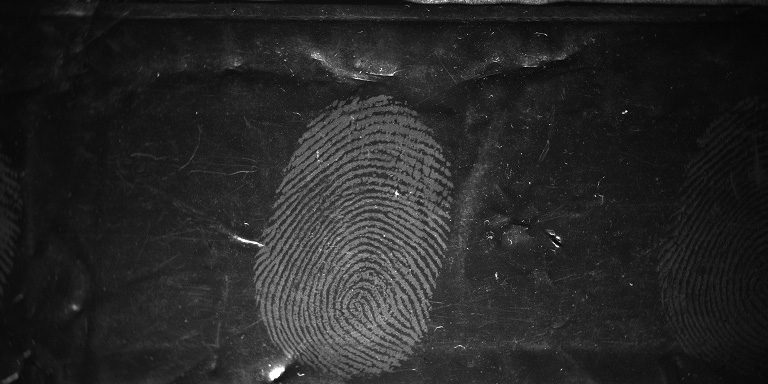
While many latent prints are typically developed by dusting, there are other methods of developing fingerprints that rely on chemicals. First, it's essential to understand that fingerprints cannot be lifted from all surfaces. A porous surface or a surface with an uneven texture (such as a concrete block or rough-faced brick) cannot hold fingerprints. However, fingerprints may sometimes be recovered from unlikely surfaces, like human skin. To recover latent prints from these kinds of surfaces, sometimes investigators must use unconventional methods and materials.
Super Glue and Other Chemicals
Superglue is a quick bonding agent sold on supermarket shelves as a fast-acting glue. In 1977, a crime lab technician in Japan was examining a hair glued to a glass slide using super glue. The technician noticed that the fumes from the glue caused a fingerprint to appear on the glass. This discovery was shared, and soon the chemical in superglue, cyanoacrylate, was widely used to detect latent fingerprints on non-porous items like glass and plastic. The process is called fuming, which simply means exposing the items to cyanoacrylate fumes.
Fuming is usually done in a closed container to control the fumes. Chemicals in the fumes attach to the secretions on the fingerprints, exposing the ridges of the fingerprints. This reaction usually turns the fingerprints white.
There are other chemicals besides cyanoacrylate that can be used in the process of exposing latent fingerprints. Some of the more common chemical processes include:
Iodine fuming: used on porous surfaces such as paper
Ninhydrin: sprayed onto surfaces reacting to fingerprint secretions on porous surfaces such as paper and cardboard
Silver nitrate: used for many years to develop fingerprints on paper. The paper is dipped in a silver nitrate solution and is then exposed to ultraviolet light or sunlight to dry. A chemical reaction occurs, causing the fingerprint to appear dark brown.
Fingerprint Classification
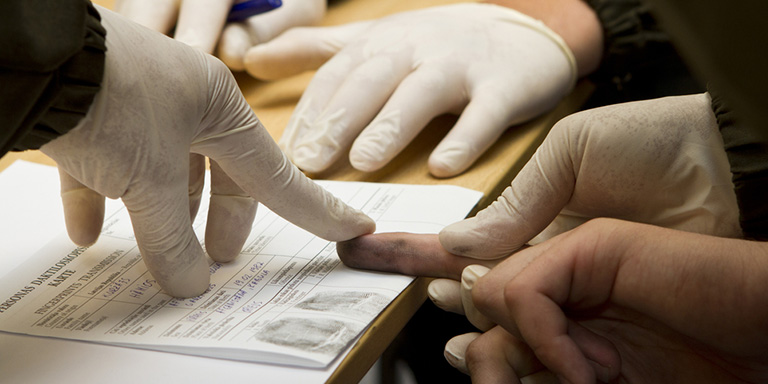
For many years, the classification of fingerprints was done by hand by fingerprint examiners. Today, computer algorithms locate the core (or center) of a print and the deltas where divergent parts of a pattern meet. The computer can read the details of the fingerprint and complete the classification. When people are arrested and convicted of crimes, their fingerprints go into an FBI database. While most departments keep a fingerprint collection of local offenders, the Bureau collects prints nationwide.
The automated system used for fingerprint classification is known as AFIS, or The Automated Fingerprint Identification System. AFIS holds the fingerprints of over seventy-three million known criminals. There are different sections for accepting full fingerprint card submissions of convicted criminals and single crime scene print submissions for comparison purposes.
The AFIS system wasn't around in 1978 when a 61-year-old man from Nebraska was stabbed to death in his apartment. The police recovered latent fingerprints and palm prints from the victim's bathroom and the victim's car, which was stolen and driven to Illinois. Some of the fingerprints in the bathroom were in the victim's blood. Cigarette butts that were found at the scene and in the victim's car were preserved as evidence. The police searched local and state fingerprint records, but no match could be found. For many years, the case went cold until technology finally caught up.
Two Omaha investigators working for a newly formed cold case unit in 2008 used the AFIS system and came up with a match for the old latent prints in less than five hours. The offender, Jerry Watson, was already in jail for burglary but was due to be released.
The investigators obtained an order for Jerry's DNA which matched DNA recovered on the cigarette butts collected at the crime scene and in the victim's stolen car. Watson was interrogated at length but maintained his innocence, lying repeatedly about his involvement. At trial, the bloody fingerprint match and a DNA match sealed Jerry Watson's fate. He was found guilty thirty-three years to the day after he committed the murder. Watson was convicted of first-degree murder and received a life sentence. In this case, the evidence had to wait for decades until the technology was invented to identify the fingerprints and convict the killer.
Finding, collecting and matching fingerprints has been a driving force in convicting criminals for many years. While eyewitnesses may become unsure over time, and some physical evidence may deteriorate, fingerprint evidence lasts forever. And, unlike criminals, fingerprints don't lie.