
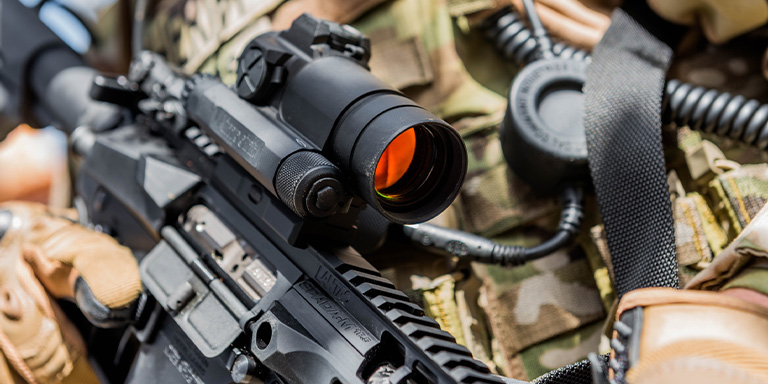
Red dot sights are among the most popular firearm accessories, and with good reason: they're one of the best and easiest ways to improve your accuracy overnight. But with many red dot sights costing $500 or more, they can be even more expensive than a new gun, so it's critical to buy the right model.
In this guide, we'll review the different types of red dot sights and explain how they work. We'll also go over their pros and cons and offer a few tips on how to shop for one.
What Is a Red Dot Sight?
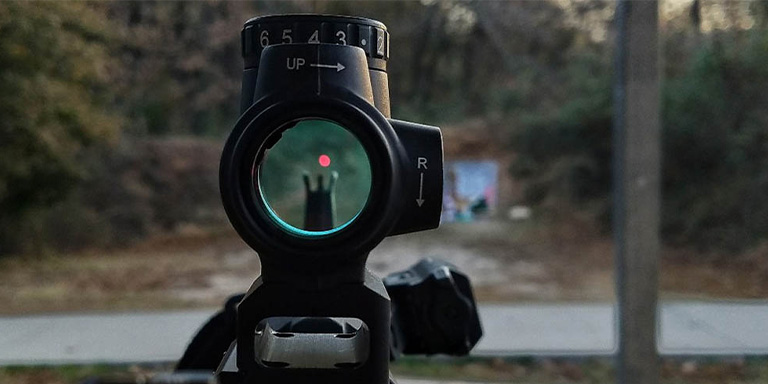
A red dot sight is one that projects a reticle (think crosshair), colored dot or overlay onto a glass screen using light, lasers and/or mirrors. Police, military personnel, hunters and precision shooters all use red dot sights for a variety of reasons, but ultimately these sights are popular because they increase both shooting accuracy and speed.
Many shooters are surprised to learn that there are three different types of red dot sights. Each has slightly different applications.
Reflex sights, so named because they're designed for reflexive shooting (or because they utilize reflective glass, depending on who you ask) are the simplest and most common type of red dot sight. Ideal for short-range engagements, reflex sights can be used with handguns, rifles or shotguns.
Holographic sights are more expensive, larger and bulkier than reflex sights, so they're normally only seen on long guns. They have better light transmission, which results in a brighter, clearer sight picture, and they can have more complex reticles.
Unlike the previous two types of red dot sights, prism or prismatic sights don't require power (although some can optionally be powered), and they can offer magnification up to 5x. However, they're not as good for situations in which maximum speed is essential.
Pros of Red Dot Sights

These sights offer a number of advantages that are difficult or impossible to find in other optics. Here are a few of the pros red dot sights have to offer.
Improved Speed and Accuracy
Even though most of us learned to shoot with iron sights long before we started experimenting with fancier optics, iron sights aren't the greatest way to aim. It takes a fair amount of practice to correctly align the front sight, rear sight and target, and it's even harder to do so with lightning speed.
Red dot sights only require you to focus on the target and on the dot itself. Focusing on two things instead of three may not sound like a huge difference, but it is. Assuming the sight is installed and calibrated correctly, you can expect to acquire your target much more quickly, and you should notice big improvements in your accuracy, too. Novice and expert shooters alike can benefit from red dot sights.
Greater Eye Relief
Eye relief is a complicated visual phenomenon, but to keep it simple, it's the precise distance and angle at which you must look through a scope to get a clear, well-aligned sight picture. Standard scopes can be tricky; if your eye isn't positioned just right, you'll have a hard time hitting anything.
Red dot sights are much more forgiving. As long as you can see the reticle, your shot should be right on target (again, assuming the sight is installed and zeroed properly).
Better Stance and Grip
Iron sights can sometimes encourage poor shooting ergonomics, especially if the target is above or below you. But with a red dot sight, you can't even see the reticle unless your posture and grip are more or less correct. With repeated practice over time, you'll get much better at quickly assuming a perfect firing stance.
Improved Situational Awareness
When you have a choice, it's best to shoot with both eyes open, but iron sights and some kinds of optics can make it hard to do so. Closing one eye makes it easier to line up a shot at the cost of sacrificing half your vision. Red dot sights are designed to be easy to use with both eyes open, meaning you can maintain much greater tactical awareness and avoid tunnel vision.
Zero It and Forget It
As long as you buy a decent-quality red dot sight that mounts tightly on your gun, you should never have to re-zero it unless it gets knocked out of alignment. Be sure to read up on how to zero a rifle to make sure you're up to speed.
Cons of Red Dot Sights
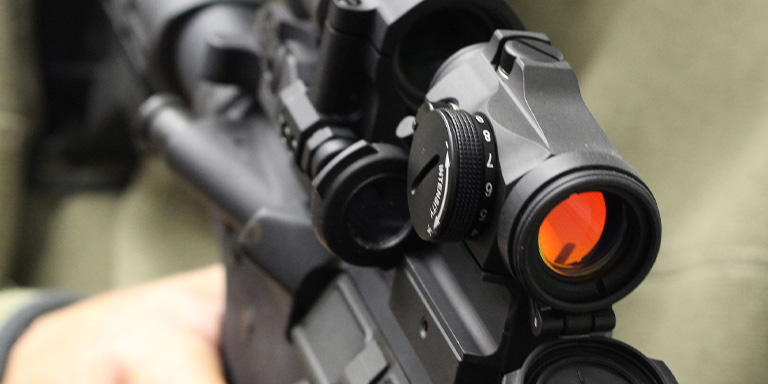
Like anything, red dot sights have their drawbacks, but they're not too hard to manage once you're aware of them. It's important to keep some of the following disadvantages in mind before you buy.
Weight and Bulk
Anything you attach to your gun makes it bigger and heavier. It'll take some extra practice to maneuver your weapon quickly and precisely with a fairly large optic on top.
Cost
Well-made red dot sights aren't cheap, and top-tier models can be well over $500. Would you rather have a new optic or a new gun?
Potential Overreliance
Any device designed to make something easier has the potential to become a crutch. Red dot sights are a great investment as long as you keep your basic shooting fundamentals sharp. Be sure to periodically train without your red dot sight so you don't become wholly dependent on it.
Holster Woes
As soon as you add attachments to a handgun, your holster choices become much more limited. You may not be able to find a holster designed for your particular pistol that can also accommodate a large optic. Universal holsters that are sufficiently large are often too large to securely retain the weapon. For more help on finding the right holster to accommodate a red dot sight (or any other attachments, for that matter), our guide on how to choose a gun holster has you covered.
Red Dot Sight Anatomy and Function
Red dot sights work because of “Pepper's Ghost,” an optical illusion known to stage magicians since the mid-19th century. When two or more mirrors are positioned just so, and when light is bounced off them at the right angle, objects reflected in the mirrors can appear to be somewhere other than where they actually are. This is why red dot reticles appear to float in midair — the image is reflected onto a transparent screen from somewhere farther back in the housing.
Mounting Systems
A red dot sight can be mounted on a weapon in several ways. Models intended for use with rifles or shotguns tend to have traditional clamp or rail mounts, of which there are many different styles. Mounting systems for semi-automatic handguns are a little more complicated. Again, there are many different types of mounting hardware, but because the slide moves, sight mounts must attach to the rail or frame of the handgun. The main takeaway here is that red dot sights for handguns are almost never universal; they're model-specific, and you need to buy one designed to fit your particular handgun.
Open and Closed Designs
Red dot sights are either open or closed. Open designs are those in which a significant part of the unit is exposed, whereas closed models are completely covered by some kind of housing. Closed designs tend to be heavier and bulkier, but they're more durable and less vulnerable to dirt and debris. They're also less affected by changing light conditions, which can have dramatic effects on the visibility of the reticle.
Lenses and Magnification
Some red dot sights use a single lens, whereas others have two. In either case, the vast majority are one-power sights, meaning they offer no magnification. This is typically a deliberate design choice; the main purpose of a red dot sight is to maximize your speed and accuracy, but when magnification enters the equation, you start having to do math — not a particularly fast activity, even for the brightest of us.
This doesn't mean that magnification is completely off the table. Holographic and prism sights are sometimes offered with magnification options because they're often marketed to rifle shooters for whom speed isn't the most important factor. You can also buy aftermarket magnifiers meant for use with reflex sights, but this means adding two separate attachments, which might make your weapon overly bulky and awkward. The best magnifiers come with selector switches so you can quickly toggle magnification on or off.
Reticle Size and MOA (Minute of Angle)
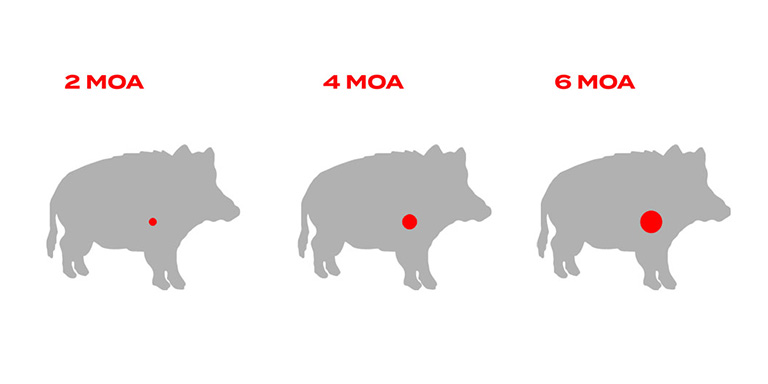
Red dot sight reticles come in various sizes. The most common are 4-MOA models, in which the reticle will cover 4 inches at a distance of 100 yards (1 MOA is 1 inch at 100 yards). Larger reticles are best for maximum speed at close range because they're much easier to see, and it's easier to acquire your target quickly. Your shot might be off by a few inches, but in most cases, that's not a critical difference. Conversely, smaller dots sacrifice speed for accuracy and are best when there's little room for error.
The simplest red dot sights have only a single dot for a reticle, which some shooters prefer. More complex (and usually more expensive) models have reticles that provide more information, such as MOA adjustments, multiple concentric reticles or full crosshairs. Individual preferences vary, but in general, simpler reticles are best for short-range engagements wherein speed trumps all other concerns.
Reticle Color and Resolution
When you unbox and install your brand-new red dot sight, you'll notice that the reticle is a bit fuzzy, and no amount of adjusting will bring it into crystal-clear focus. Don't return the sight — this is normal. Each time light is reflected, the beam or image becomes a little more distorted, and there's no way for technology to compensate for this limitation (at least, not yet).
In the past, all red dot sights had red reticles, hence the name. Some newer models offer green or blue reticles, and these colors can have substantial advantages over red. Of these three colors, red is the hardest to see in bright light, so green and blue reticles are ideal for daytime shooting. However, green and blue emitters consume more power, so keep that in mind (fresh batteries should still last you at least one year).
High-end holographic and prism sights sometimes come with etched reticles that you can see even when the unit has no power. Whereas illuminated reticles are harder to see in bright light, etched reticles have the opposite problem: they're difficult to see in the dark when unpowered.
Other Considerations
Though we've covered a lot so far, there are a few other variables to take into consideration before purchasing a red dot sight. Think about some of the following before you make your final decision.
Battery Life
Modern red dot sights have excellent battery life; some can go as long as five years on the same battery. If the battery doesn't last at least one year, something is likely wrong with the sight and it may need to be repaired. Cold weather has a negative effect on battery life, and green and blue reticles cause battery life to drain quickly.
Durability
Any mid-grade or high-end red dot sight should be built to withstand the rigors of combat. However, they're made with glass and have delicate electronics inside, so hard impacts can still break them. Entry-level models are even more fragile and not suitable for life-or-death situations (although they can be good for basic target practice).
Co-Witness Sights
In shooting, the term “co-witness” refers to two different sighting systems meant to be used at the same time or in rapid succession. A common example is offset iron sights sometimes found on scoped rifles. The iron sights are usually mounted at a 45-degree angle and can be folded down when not in use.
Red dot sights are firearm-specific in part because they must be compatible with the gun's original sights. The wrong red dot sight could be unusable if the iron sights interfere with your sight picture or physically prevent the sight from being mounted properly. When aiming through a correctly-installed red dot sight, it's okay if the gun's original sights are visible in the optic window, but they shouldn't overlap any part of the reticle.
Night Vision
Most red dot sights are incompatible with night vision devices because the illuminated reticle is blinding when amplified tens or hundreds of times. However, night vision-compatible models do exist. On these sights, the brightness of the reticle can be lowered such that it's invisible to the naked eye but looks normal with night vision. If you're interested in learning more, take a look at our guide on how to choose night vision optics.
Red dot sights can be expensive and slightly tricky to use at first, but many shooters find that their advantages significantly outweigh their drawbacks. These sights are especially useful for shooters who need to maximize their ability to fire quickly and accurately at short range. As long as you can comfortably afford one, we recommend making the investment.