

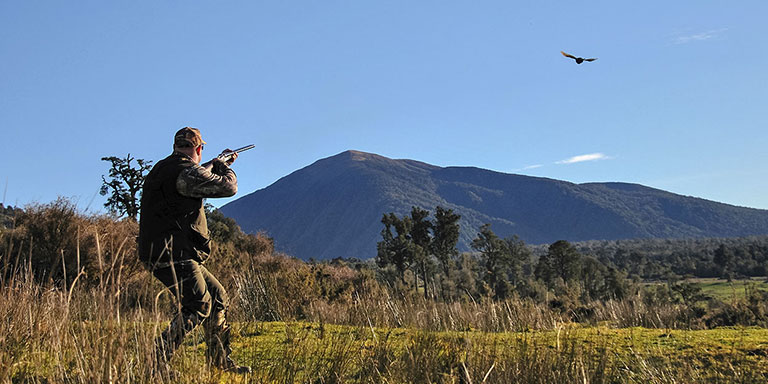
Excluding hunters, a majority of gun owners never fire at a moving target. That's potentially a big problem, especially for those who own a gun primarily for self-defense, as they may lack some essential marksmanship skills in a time of critical need.
Like many technical firearm skills, there's only so much you can learn about hitting a moving target by reading an article. Still, it's helpful to have a basic foundation of knowledge before you start practicing. In this guide, we'll cover need-to-know techniques, tips related to your stance and suggest some training methods for you to try.
Safety First
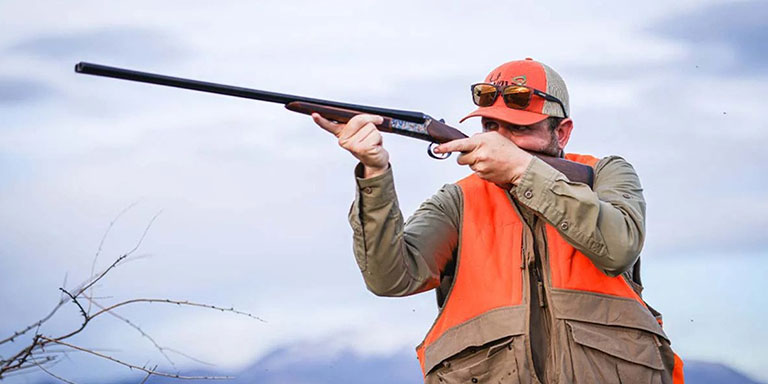
Many of us spend so many hours shooting at stationary targets on the range that gun safety in that context becomes second nature. That's a good thing, but it can become a bad thing outside of the familiarity of the range. If you've never shot at moving targets before, there's a whole new layer of gun safety to learn, especially if you're using one of the partner-assisted practice methods we'll describe later.
In short, when the barrel of your gun is moving around, it's even more important to be fully aware of your surroundings before you pull the trigger. To begin with, practice shooting at targets that move very slowly. Not only is this a good way to start getting the technical skills down, it also makes it much easier to know exactly where your muzzle is pointing at all times.
Fundamentals of Long-Range Marksmanship
Before you can reliably hit moving targets, you'll first need to have some solid proficiency in the fundamentals of long-range shooting (even if you shoot primarily with shotguns or handguns, many of the same principles apply). It's much easier to learn new techniques when those underlying them are second nature.
Hitting a Moving Target: Three Different Techniques
Although hitting a fast-moving target is not easy, it's not as hard as it may seem. First and foremost, practice keeping your cool, and emphasize accuracy over speed. Many shooters feel like they have to fire at the target as soon as it comes into view. This usually results in a miss, because you haven't had enough time to accurately estimate the target's distance, speed and direction.
You should also become comfortable with not firing at every opportunity. In some cases, you simply won't be able to line up a good shot quickly — perhaps the target is too far away, moving too fast or isn't visible for very long. Let it go and wait for the next one. A well-aimed shot taken at the right time is much better than a hasty one that was never likely to hit the target.
Tracking
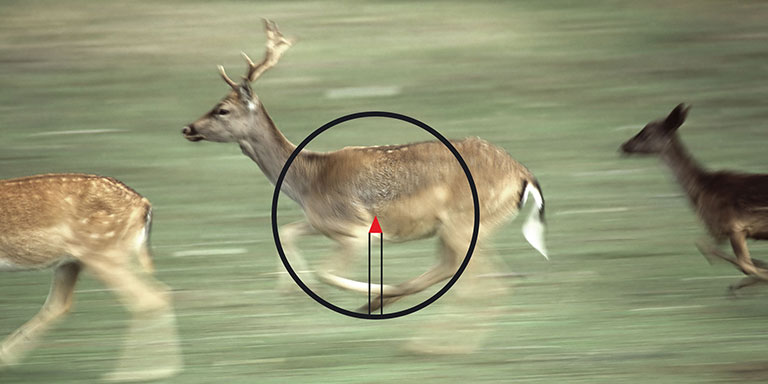
Sometimes called the "pull-away" method, the tracking method is the simplest and most reliable method of hitting a moving target, but it's also the slowest. It's ideal for use in open country with few obstacles or visual impediments. When you first see the target, follow it with your muzzle for several seconds. Once you've got a feel for its speed and direction, move your muzzle smoothly ahead of the target by an appropriate distance (don't jerk the barrel), and emphasize a steady, clean trigger pull.
This method is part intuition and part muscle memory. Unlike precision long-range marksmanship, which often involves complex calculations, moving targets don't give you enough time to do math. Even so, the human brain is an amazing calculator, and you already have the ability to estimate and integrate many complex variables such as distance and speed. Think about the simple act of catching a ball—when you work out the math and physics involved, there's a lot going on, but your brain can automate the process with great speed and accuracy.
To an extent, tracking a moving target involves "just feeling it," but this alone isn't enough. You'll have to practice regularly in order to hone this intuition into a consistently repeatable skill.
Swing Through
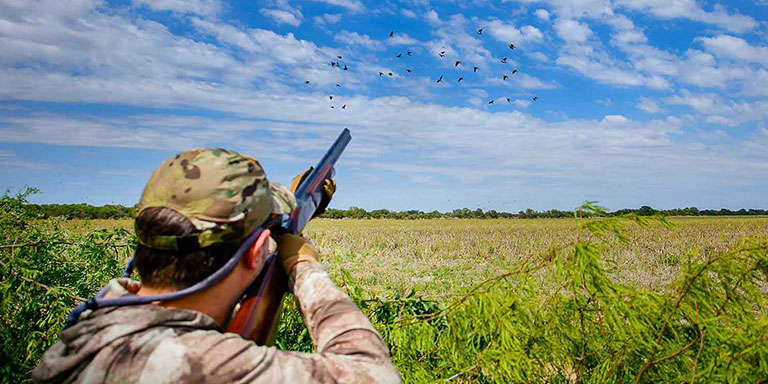
A "swing through" shot is more difficult than a tracking or ambush shot, in part because it involves deliberately tricking your own brain. This technique is regularly used by bird hunters, who are often surprised by birds taking flight and have only a second or two to take a shot.
As the name implies, this method involves starting the shot with your muzzle behind the target and "swinging through" its path of travel. When objects are moving quickly, there's a slight delay between your visual perception of the object and any physical action you take in response. To put it another way: when the barrel of your gun is moving faster than the target, you'll want to squeeze the trigger when the bead or sight appears to be directly on top of it. Because of the split-second delay, when you take the shot at this time, your muzzle is actually slightly ahead of the target.
This method is one of the most difficult ways to hit a moving target, but it's an essential strategy to master should you ever need to take such a shot with very little time to aim. However, note that its effectiveness diminishes at ranges beyond about 30 meters. In such cases, a tracking or ambush shot will usually be more appropriate.
Ambush
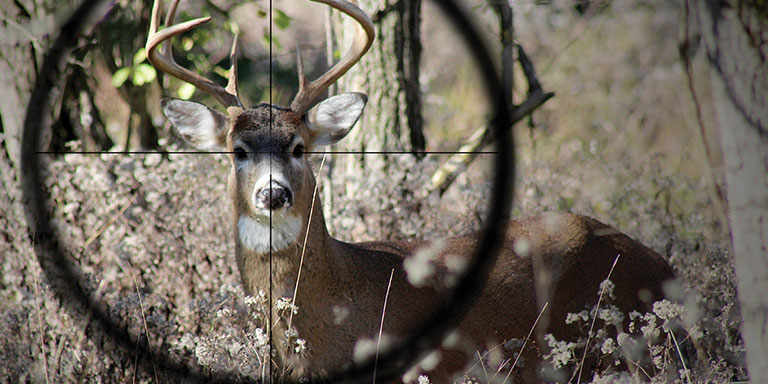
If you know where the target is going to be in the future, it's often easiest to aim at that spot and let the target come to you. This method works best in densely wooded areas or other places where the terrain gives the target few choices about where to go.
This kind of leading shot is easy to practice because you can do so without an actual moving target (at least to begin with). Practice shooting at stationary targets from different ranges, elevations and angles. Pay close attention to the bullet's flight time and how the surrounding terrain affects its point of impact. Once you have a good idea of where each bullet will land and how long it takes to get there, adding a moving target into the equation isn't too much harder.
It's important to note that, if you're shooting a rifle over longer distances, you don't want your optic to be zoomed in any more than necessary. The more of the target area you can see, the more accurately you'll be able to time your shot when the target enters your field of view. If you're zoomed in too much, the target could enter and leave your field of view before you have a chance to react.
This method is not ideal in open areas or with targets that move in unpredictable ways, so be sure to practice the other methods as well.
Shooting Stance and Position
As with any kind of shooting, your firing stance plays a big role in hitting a moving target. You may have to adopt a stance that you're not used to.
Standing
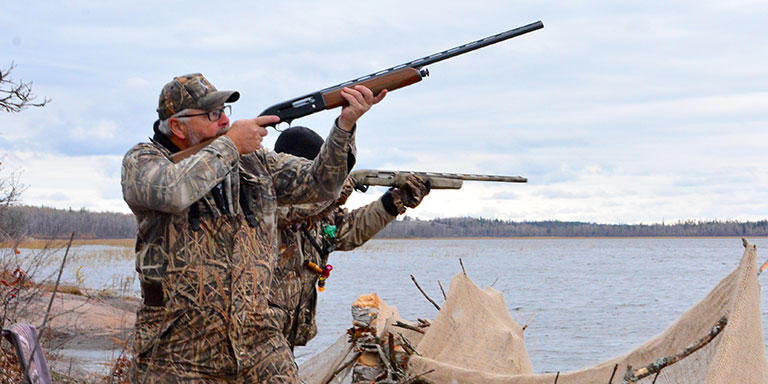
You probably shoot at stationary targets most of the time, which means your strong leg is back, your weak leg is forward, and you're braced to receive a frontal impact (if you're training for self-defense scenarios). This kind of stance offers good balance and adaptability in close quarters, but it's not great for shooting at moving targets beyond about 50 feet.
Instead, you'll want to adopt a more lateral stance, with your feet spread a little wider than shoulder width apart and your support leg only slightly rearward. Lean forward at the waist and into the stock of your weapon to help manage recoil, which will feel stronger than normal because you have less rearward support. Keep your head and arms fixed and immobile, relative to one another. This stance leaves you free to rotate at the waist without moving your upper body at all, maximizing your ability to track a moving target without compromising your grip or sight picture.
Kneeling
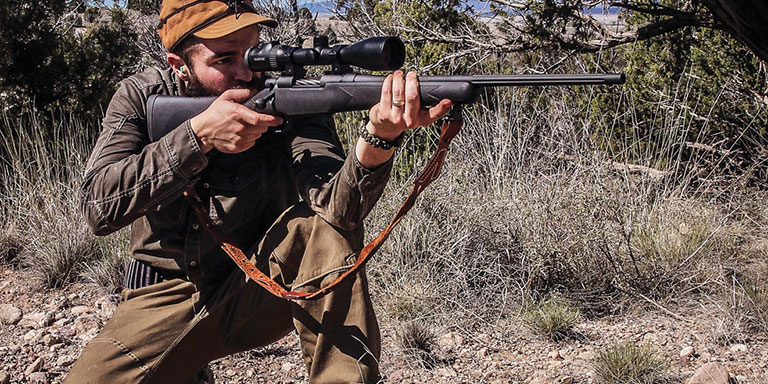
From the waist up, shooting at a moving target while kneeling is basically the same as doing so while standing. There are a number of ways to arrange your legs and feet; feel free to use whichever provides the best balance of comfort and stability. The important thing is to keep your upper body as still as possible. Rotate at the waist to move your muzzle as needed, rather than moving your head or arms.
Prone
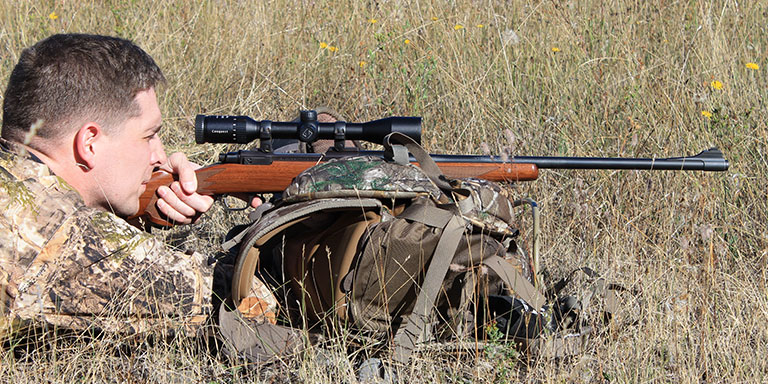
In a way, shooting at moving targets while prone gets easier the farther away the target is. Think about a target running right in front of you at a 90-degree angle—you'd have to move your rifle barrel very quickly, which isn't easy to do when you're lying down. But if the same target is moving the same speed 100 meters away, you can track it with much slower, smaller adjustments.
Tracking a target while prone is easiest with a swiveling bipod designed for that purpose. If you don't have one, use sandbags or something similar for support. It's easier to turn the barrel of your rifle left and right if it can pivot on a fixed object rather than on your supporting elbow.
Other Variables
We could lay out lengthy explanations about how distance, speed, angles, elevation and wind affect your ability to hit a moving target, but we've found that it's much more helpful to just start practicing. As you put rounds downrange and analyze what happened in each case, you'll start connecting all of these dots naturally.
One thing to keep in mind: don't forget the rifleman's rule if you want to hit anything beyond 100 meters or so. If your target is higher or lower than you are, you'll need to adjust your point of aim downward in both cases. This seems counterintuitive if you don't do much long-range rifle shooting, but once you get in the habit, you'll notice big improvements in your accuracy.
Best Ways to Practice
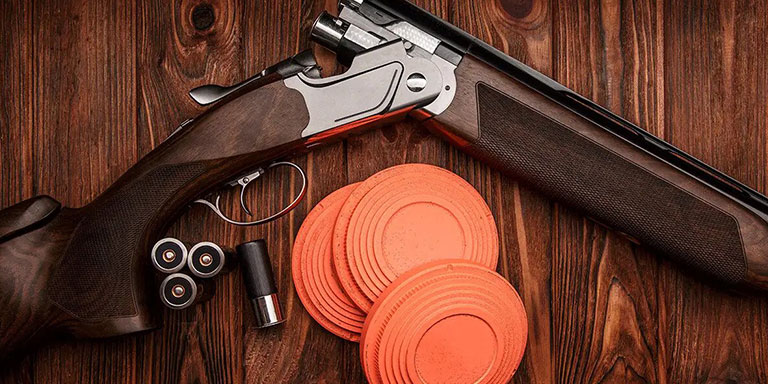
There are a few ways to practice shooting at moving targets. Ranges that offer motorized targets aren't very common, but it's the safest and most convenient option, so we recommend using such a range if there's one near you.
Practicing trap, skeet or sporting clay shooting is an easy way to get started. All of these are fairly inexpensive sports with communities that are generally friendly and welcoming. You'll find many veterans who are happy to share their knowledge and experience with you.
If you have lots of land and a safe backstop, you can attach targets to old tires and roll them downhill, or have a partner do it for you. Alternatively, if you're mechanically inclined, you can set up a simple pulley system and have a partner pull targets by hand or by driving a vehicle (a pulley system makes it easy for your partner to be behind you, as opposed to being in your line of fire.) Always exercise extreme caution whenever you're doing live fire exercises with another person nearby.
Finally, you can buy or make pendulum targets that move on their own with simple mechanisms. These targets do have shortcomings, though. Most notably, the movement is constant and predictable, so they're great for beginners but less useful once you're ready to practice under more realistic conditions.
Like most advanced shooting disciplines, hitting a moving target is a difficult skill that requires proficiency in several others. Now that you know the basic techniques, the best thing to do is hit the range and start practicing.