

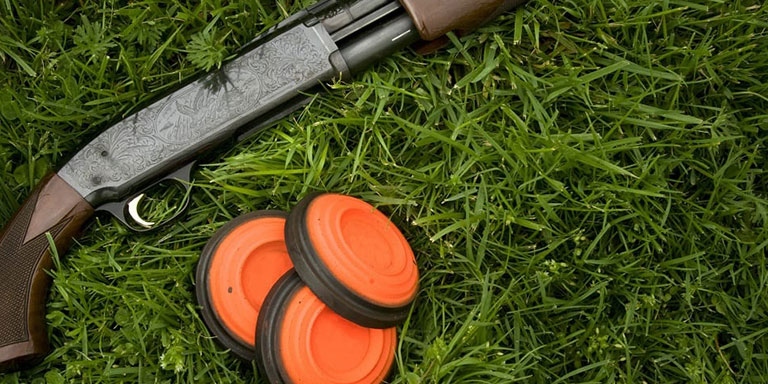
Some competitive shooting sports are complicated, requiring newcomers to learn many rules and variations. In comparison, trap, skeet and sporting clay events are fairly simple (although not easy). All of them are great ways to meet new people and to improve your ability to hit fast-moving targets.
In this guide, we'll briefly review the history of clay shooting and lay out the basic rules of each event. We'll also offer some tips on etiquette and recommended equipment for beginners.
A Quick History of Clay Shooting
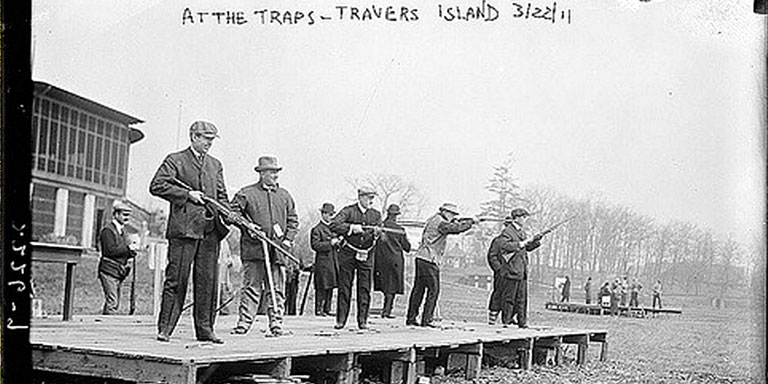
Clay shooting (also called "birds" or "clay pigeons") was born in the late 19th century. Prior to that, wealthy sportsmen often used live birds for target practice, but this was an expensive hobby. In the early 1880s, hand-thrown clay targets began to replace live birds, lowering the financial cost considerably and thus allowing shooters of more modest means to participate. A few decades later, around 1915, automated throwers entered the marketplace, lowering the long-term cost of the sport even more (because shooters and clubs no longer had to pay someone to throw targets).
Today, clay shooting is enormously popular, partly because it's a relatively affordable way to practice the hardest kind of shooting there is: tracking and hitting fast, airborne targets that are moving perpendicular to the shooter. Those who can master this difficult skill will be well-prepared for other shooting sports, hunting and self-defense.
Trap
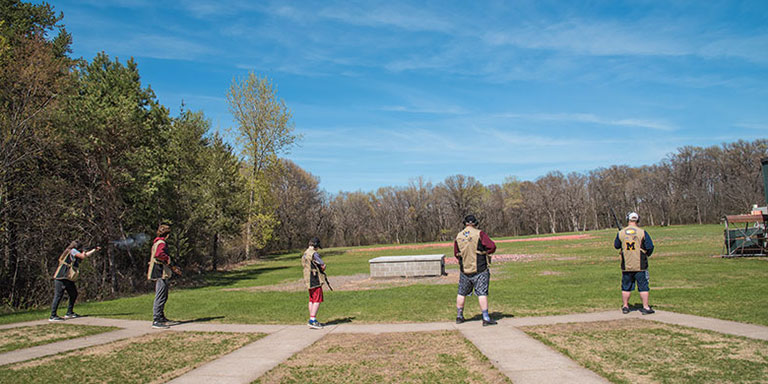
Complexity and difficulty are different things; in the context of shooting sports, the former refers to the number or specificity of rules and techniques, whereas the latter describes how physically or mentally challenging it is to perform the required techniques. Trap shooting is arguably the least complicated and least difficult form of clay shooting (although it is by no means easy), making it our recommended starting point for beginners. Shooters with more experience may want to try their hand at metallic silhouette shooting.
There are many variations of trap shooting; American trap is the most common. This ruleset is further divided into three subcategories: singles, doubles and handicap. In all of these categories, clay targets are launched from a single thrower located in a stationary "trap house," and the shooter fires at these targets from one of five fixed positions, each located 16 yards from the trap house. Shooters compete in teams, and points are scored by hitting targets. Generally, it's a binary scoring system wherein every shot earns either full points or no points — any hit, even a partial hit that doesn't completely shatter the target, is counted and scored.
In singles, only one target at a time is thrown. This is the best way for beginners to start practicing the sport's most fundamental skills.
As you might expect, doubles means that two targets are thrown at once; nothing else changes. Targets are scored individually, so shooters still get some points even if they hit only one target.
Handicap is the same as singles, but it's made harder for more experienced shooters by placing them farther from the trap house, out to a maximum distance of 27 yards. This means that, by the time the target enters the shooter's field of view, it's been airborne for longer, and the shooter has less time to hit the target before it exits the shooting area.
Most competitors use double-barreled, over-under shotguns for doubles matches and single-barreled shotguns for singles and handicap. Pump-action and semi-automatic models are fine both for recreational shooting and official ATA matches, but they may be banned in some regional clubs. Generally, shotguns must be at least 12-gauge, but smaller gauges are allowed in some events. Shot size can be no bigger than #7 ½. Shotshells used for clay shooting contain many more pellets than those used for most other purposes, increasing the chances of a hit. Modern trap guns often have quick-change choke systems so that shooters can easily swap chokes for different events and distances. Shooters are welcome to practice alone or with a team of less than five members, but official events require teams of five shooters.
The majority of official events in the United States are governed by the Amateur Trapshooting Association (ATA), although the Pacific International Trap Association (PITA) governs some events in the western U.S. and Canada. These two organizations use nearly identical rules.
Skeet
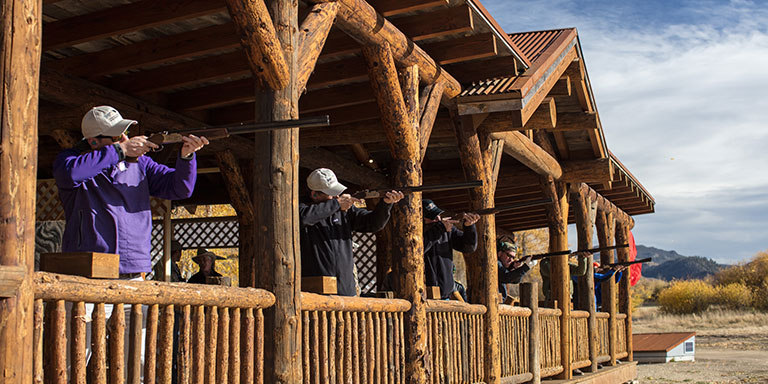
If trap shooting is designed to help shooters develop and refine essential skills, then skeet shooting is meant to test those skills. More variables are introduced, and the overall pace is faster, demanding quick reflexes and a high degree of adaptability from the shooter.
In America, the National Skeet Shooting Association (NSSA) governs and regulates all official events. As with trap and sporting clay shooting, there are many different variants, but in this case, we'll discuss NSSA rules because they're the most common.
There are eight shooting stations (compared to five in trap shooting)
Targets are launched at 45 miles per hour (up from 40 in trap shooting)
Targets may be launched at different heights (in trap shooting, target height remains constant).
As with trap shooting, shot can't be larger than #7 ½; most experienced skeet shooters recommend #9 shot.
Rules regarding shotgun type and gauge are mostly the same as those described above for trap shooting under ATA rules.
Sporting Clays
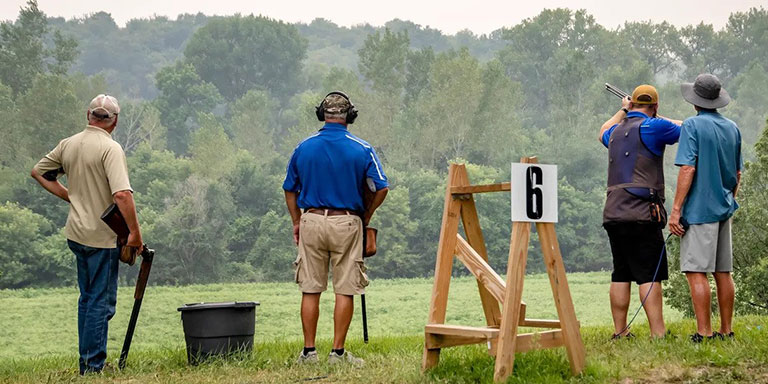
The most complex, most difficult, and (in our opinion) most fun variant of clay shooting is sporting clays. Many participants affectionately refer to it as "gun golf." This event closely simulates bird hunting by challenging shooters in the following ways:
-
The course is much larger. There are many different stations (usually ten to fifteen), and participants walk between them, much like golfers move from one hole to the next on a golf course. Each station features different types of targets with different characteristics.
Standard or "pheasant" targets are 108mm in diameter
"Midi" targets are 90mm in diameter and faster than standard targets
"Mini" targets are 60mm in diameter, and they have high initial velocity but lose it quickly
"Pro" targets are between midi and mini targets in terms of size (70mm) and velocity
"Rabbit" targets are the same size as standard targets but rolled across the ground instead of launched into the air
"Battue" targets are 108mm in diameter and very thin, meaning they're very fast at first but rapidly lose speed and height
There are few rules concerning the layout of the course and the presentation of targets. Safety is the prime consideration in course design, but within those limitations, courses are often changed to keep regular shooters interested.
The initial speed of the targets, their height, their delivery sequence, their direction of travel and the number of targets per station can all vary.
Whereas trap and skeet squads are composed of five members, sporting clay teams range from two to six.
Quick-Start Guide for Beginners
If you're ready to try your hand at any of these (highly addictive) sports, here are a few tips to maximize your chances of a smooth start.
Etiquette
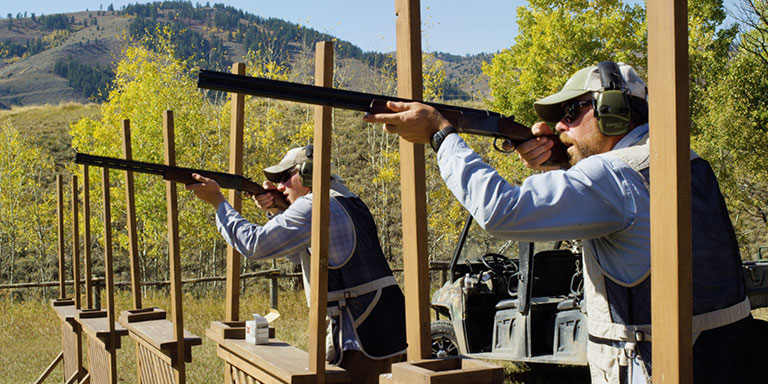
All competitive shooting sports have their own codes of etiquette, but this is an especially important consideration in clay shooting. Experienced clay shooters are generally friendly and welcoming as long as you follow these simple rules.
Use a shell catcher if you have a pump-action or automatic shotgun. If your empty casings hit or otherwise distract shooters next to you, it'll likely break their concentration. Fortunately, this display of rudeness is easily avoided.
Don't talk unless you must, and if you must, talk quietly. Talking is distracting to shooters on the line, especially nowadays, as many shooters wear electronic headphones that can amplify voices.
Always keep your gun empty, with the action open and the muzzle pointed downrange, until it's your turn to shoot. Never, ever violate the basic rules of gun safety.
When shooting in a squad, pay close attention to what your teammates are doing, and be ready when your turn comes up. Few things annoy clay shooters more than a teammate who doesn't know what's going on.
Load one shell at a time, or two for doubles. This is a safety issue; other shooters need to know that your gun is empty at all times except when you're actively shooting.
When you're shooting at a club, ask someone what the club rules are. Rules may vary from one place to another, and ignorance of the rules isn't an excuse for breaking them.
Don't ask for extra targets. Your membership or range fee includes an exact number of targets, and it's considered rude to ask for more. It's also rude to extend your turn, thus making other shooters wait longer.
Tip the trap kid, if there is one. Today, many courses are fully automated, but some still employ people (often teens and twentysomethings) to follow you around the course, keep your score and launch your targets. It's a thankless and potentially dangerous job, so offer them a nice tip if you can afford to.
Recommended Equipment
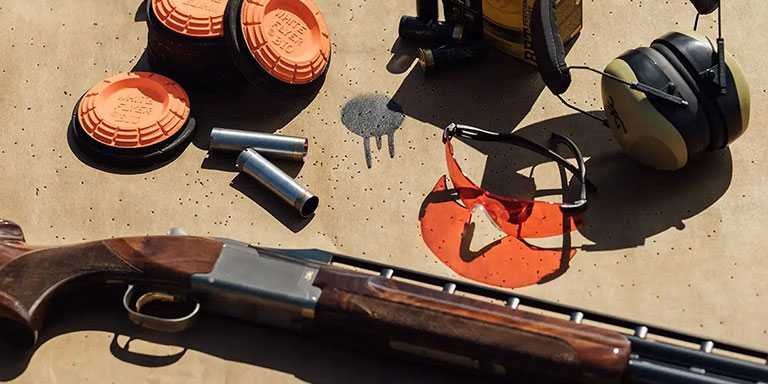
One reason that clay shooting is so popular is that it's fairly inexpensive compared to most other shooting sports. You don't need much equipment to get started.
A reliable shotgun of virtually any make or model (except those which can chamber two different gauges at the same time — they're usually not allowed)
A shell catcher, if needed
A vest, bandolier, or belt pouch to hold spare shells
Hearing and eye protection (we recommend electronic headphones so you can easily hear instructions and feedback)
Basic range bag to carry extra boxes of shells
A few different chokes (optional, especially when you're first starting out)
Choke wrench (also optional)
A pair of shooting gloves, if you'll be shooting in cold weather
Tips for New Shooters
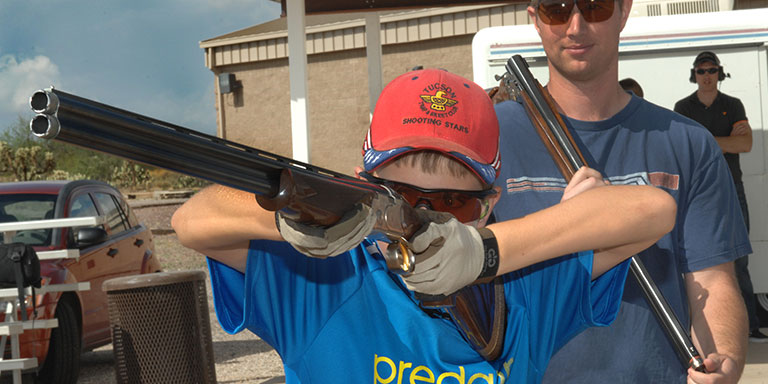
We've said it before, but it bears repeating: Clay shooting is hard, and it takes time to master. Keep these basic tips in mind when you're first starting out.
Be patient and cut yourself some slack. Most clay shooters don't hit much (or anything) during their first several outings. This sport combines several high-level skills and mastery comes gradually.
Don't exclusively commit to one event right away. Try trap, skeet and sporting clays to see which one you like best. You may surprise yourself.
Keep both eyes open. Many shooters prefer to close one eye, and that might be okay on the regular range, but one-eyed shooting significantly hampers your ability to estimate the distance and speed of a moving target.
Practice your stance; experienced clay shooters often say that most newbies neglect this. Overall, your body should be more sideways than it would be for regular target shooting. Keep your feet about shoulder-width apart, put about 60% of your weight on your front leg, and lean slightly forward at the waist. This stance makes it much easier to accurately track a moving target.
Learn proper mounting (aiming) and muzzle follow-through. These concepts are difficult to describe in writing, so watch videos or ask an experienced clay shooter for guidance.
Take your time. Many new clay shooters fire at the target as soon as they see it, which usually results in a miss. Take a moment to see where the target is, where it's going and how fast. You only get one shot at each target, so make it count.
Use light, low-recoil loads. They'll save your shoulder and your wallet, and they'll break clays just as well as heavier loads.
Learn whether you're right or left-eye dominant, if you don't know already. Trying to shoot moving targets without knowing your dominant eye will bring endless frustration.
Learn to regard misses as opportunities. In the beginning, you will miss most of your targets. After shooting, think carefully about the shot you just took, try to identify what caused you to miss and focus on doing that one thing better next time.
Clay shooting is one of the most popular firearm sports in the world, and we can see why. It's challenging, yet accessible to beginners. It's also cheaper than most shooting sports (because you don't use much ammo), and it's easy to find a community of friendly experts who can teach you a lot. Now that you've read our guide, you're ready to try it out for yourself.