

Domestic violence is broadly described as any incident resulting in physical or psychological harm, bodily injury or an act threatening violence. To be considered domestic violence, these acts must be committed between current or former family or household members or those with a defined relationship.
Every state has a different definition of what acts constitute domestic violence, as well as what factors determine the necessary relationship between the parties. Each officer must learn the laws defining domestic violence in their particular state.
Understanding the History
In the 1970s, violence in the home was narrowly defined as a crime committed by a husband against their wife. The definition usually included physical violence and usually signs of serious injury. Some of these statutes labeled the crime as wife-beating. Over time, the laws broadened and evolved to include a group of offenses collectively called domestic violence.
Initially, officers were allowed great latitude in investigating domestic violence cases. Often, officers insisted the parties be separated for the night, with the accused transported away from the scene to cool down at a relative's home. This was especially true when one or both parties were intoxicated. Officers using this informal resolution method usually failed to document the incident and did little to solve or address the underlying pattern of abuse.
Under-enforcement and informal resolutions led to the removal of police discretion in most cases. This lack of enforcement action led to repeated acts of abuse and, in some cases, even murder. Current domestic violence laws include detailed identification of what constitutes an act of domestic violence and when mandatory arrests must be made. In many cases, the investigating officer must arrest perpetrators under penalty of law.
Today, the investigating officer must understand all the acts defined as domestic violence. It's no longer identified as an action between a husband and wife. Each officer must also learn the expanded definition of who may be a victim or an accused.
Initial Investigation

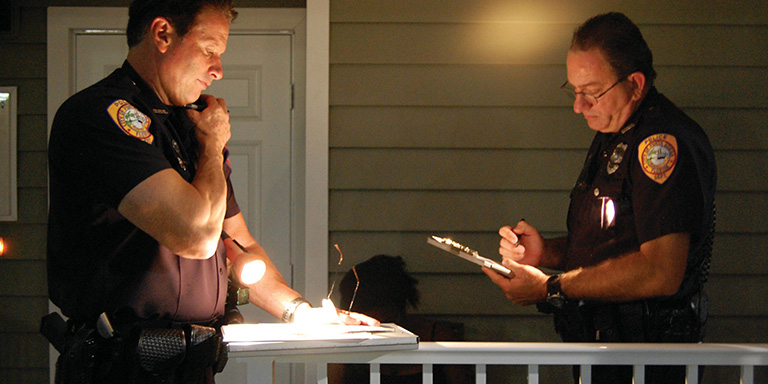
Responding to a domestic disturbance call should always involve at least two officers. If either or both parties are injured, summoning medical assistance should be the priority.
The parties involved must be separated, with one officer accompanying each. The separation, if possible, should be far enough away that they can't continue to argue. Usually, one party remains inside the home and one outside or in another room. The kitchen is a bad location for an interview as it contains knives and other potential weapons.
Persons involved in domestic violence incidents are often highly emotional and may act out irrationally and violently. Both parties in a domestic disturbance have the capacity for violent behavior directed towards police, and domestic disturbances continue to be one of the most dangerous types of calls for police officers. For tips on how to best facilitate a calm, peaceful encounter, read our guide to de-escalation techniques.
Once the parties are separated, listen to each person's version of what happened. It may be necessary to take a few minutes to calm the person down so they can clearly tell their story. Do not expect the two stories to match, as often each side will blame the other and paint the other as the aggressor.
If prior domestic violence incidents are identified, a search should be made to determine if an order of protection was filed and is still active.
Finding Answers
The investigating officer will be seeking the answer to three questions.
1. What happened?
This might sound simple, but given the usual divergence in stories, the investigator will have to determine who is more believable, given any physical evidence or other witnesses' statements.

Independent witnesses can be a big help. What a neighbor heard or saw can be significant. Speaking with a child at the scene can also be helpful — they can tell what they saw and if there have been prior acts of abusive or violent behavior, and by which party.
2. Based on the information gathered, was a domestic violence statute violated?
Each officer must understand what acts constitute a violation of domestic violence laws in their state. Actions that don't include physical violence might be intimidation, verbal abuse, threatening behavior or stalking. It is also essential to know the legal parameters regarding who can and cannot be a victim, and who can and cannot be accused in a domestic violence scenario.
In many states, those involved in a dating relationship may or may not fit the criteria. The age of each person is one consideration, and the length of the relationship is another. Is one party a minor? Is either pregnant, or have they been granted emancipation or given adult status by a court? All these factors may be relevant depending on the particular state's domestic violence laws.
3. Who is the victim, and who is the accused?
In many cases, both parties will appear aggressive, and both may show signs of physical injury. Each will blame the other, and it will be the officer's job to look at all relevant factors to make the call identifying one party as the victim and the other as the accused. These decisions are often difficult.
Historically, men were correctly (and disproportionately) identified as the aggressors in domestic disturbances. Today's domestics are more complex, though, and may involve same-sex or gender-neutral domestic partners or several related adults residing in the same home. Most states frown upon both parties being arrested, and it is the officer's investigation that must determine which party must leave in handcuffs.
Statements of disinterested third parties carry a lot of weight. A canvas of the neighborhood may identify additional witnesses to this disturbance or any prior disturbances. Earlier recorded acts of domestic violence or previous protective orders should also be considered.
Injuries can also be a deciding factor, if adequately evaluated. One person may have bleeding fingernail gouges on their arms and face, while the other may only have some slight redness around their neck. If, however, the person with the neck redness was being choked, they might have scratched and clawed their attacker to get away. These would be considered defensive wounds. While the person with the scratches may have more significant injuries, in this case, they would be identified as the aggressor.
Photographic Evidence
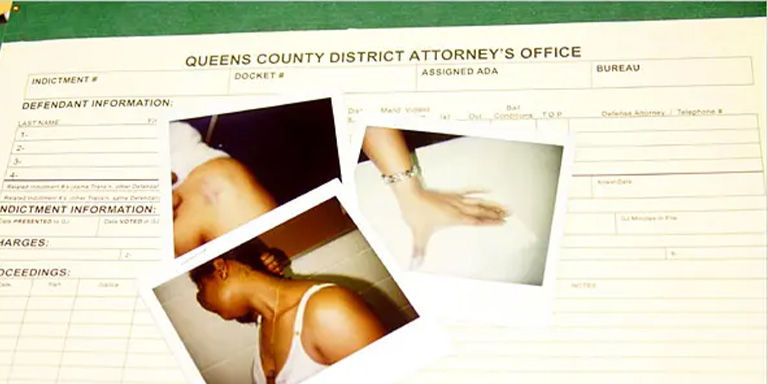
A small digital camera should be in every officer's patrol bag and be on hand during domestic disturbance investigations. Documenting the incident will include photographing the location where domestic violence acts occurred, including any damaged or broken household items or overturned furniture. Both the victim and the accused should be photographed at the scene. Photographs should show the condition of their clothing and any injuries they may have sustained. Any weapons involved should be photographed and then collected as evidence. Photos will often reveal things that are not included in the police report. A picture can be worth a thousand words.
Whenever possible, conduct a follow-up meeting with the victim 24-to-48 hours after the incident. Faint red marks initially photographed may now be large blue and purple bruises. These should be re-photographed, and the photos entered into evidence.
Making the Arrest

Victims were often very reluctant to sign complaints against their domestic partner for several reasons. These may include fear of future abuse, loss of continued financial support and the embarrassment of being identified as a victim. In many jurisdictions, police officers are now mandated to sign complaints against the accused. This helps protect the victim and ensures the complaint will not be dropped by the victim while under duress. All appropriate violations should be charged.
Once police identify the aggressor, an immediate arrest should be made following applicable state statutes. Often the accused will flee the scene before the officer's arrival. In these cases, officers must make an immediate and significant effort to locate and arrest the accused. If the accused is not located, the officer's efforts to find the accused must be well documented in their report. Shop Handcuffs
Obtaining a Protective Order

Most states have a procedure for obtaining an emergency restraining or protective order from a judge. During regular business hours, this may involve transporting the victim to a courthouse. During evening hours or on weekends, different procedures will apply, which are specific to the jurisdiction.
Protective orders usually restrain the accused from having any further contact with the victim, including returning to the residence. These are court orders which, if violated, require immediate incarceration, usually with high bail.
While protective orders can prevent continued acts of domestic violence, there are two potential problems. First, they are not in force until the accused is served. If an accusee has not been arrested for the domestic violence offense, they usually have not been served with (and therefore cannot violate) a restraining order.
Second, in many cases, the restraining order bars the accused from returning to the home they own and blocks them from seeing their children. This, on rare occasions, may push the accused over the edge, making them act out more violently against the victim.
Seizure of Weapons
Some protective orders will direct the police to locate and seize firearms or other deadly weapons the accused may have access to or own. These protective seizures may also include barring the accused from purchasing firearms while the order is in place. The weapons seized are usually held for safekeeping while the temporary order is in place. A hearing is held to determine the disposition of the temporary order. The order may be vacated, in which case the weapons should be returned. However, some orders can go from temporary to permanent, making continued possession of firearms a decision for the judge.
Investigating domestic disturbances starts with the officer's understanding of their state's laws. The investigating officer should always begin with separating and interviewing the parties involved. Locating additional witnesses and photographing the scene is also important. The officer will then decide which party is the victim and which is the accused.
If domestic violence laws were violated, an arrest should be made. A protective order should be offered to the victim, and assistance should be given in obtaining one. A thorough investigation will go a long way toward protecting the victim and bringing the accused to justice.