

Breaking in a firearm is a controversial subject, both in terms of how to do it and whether it should be done at all. To make matters worse, the term itself is somewhat ambiguous; it can refer either to the process of “breaking in” the entire gun or it can refer specifically to the barrel of a rifle.
In this guide, we'll explain what it means to “break in” your gun (or barrel), review the arguments for and against doing so and show you how to do both.
What Does It Mean to “Break In” Your Gun?
If you search for phrases like “how to break in your gun,” you'll find two different groups of people talking about two different things. More commonly, the term refers to the process of correcting small imperfections in a rifle barrel through repeated cycles of firing and cleaning. However, it can also refer to the act of firing a handgun or rifle repeatedly in order to get its moving parts to “settle” and function more smoothly. It's more commonly done with inexpensive guns that may not be designed or manufactured as precisely as higher-end models.
A quick note about shotguns: shotguns aren't typically broken in because they're mechanically simpler than handguns and rifles, and because they aren't precision weapons. Breaking them in won't hurt them, but it isn't likely to offer any benefit.
Should You Break In Your Gun or Barrel?
Some manufacturers offer specific guidance on whether or how to break in their guns or barrels. These recommendations (if they exist) can be found in the printed user manual or on the manufacturer's website. If the manufacturer doesn't offer any specific advice, you'll have to use your judgment and make a decision based on your particular priorities.
Handguns and Rifles
As previously mentioned, it's usually not necessary to break in mid-range or high-end firearms. They're typically manufactured to incredibly precise standards and designed to perform well right out of the box. Less expensive guns, although (hopefully) not unsafe, may have slight design or manufacturing defects that negatively affect performance. Breaking the gun in through several cycles of firing and cleaning may help to correct these issues. Be sure to read up on gun cleaning and maintenance basics to familiarize yourself with that process.
Arguments for breaking in your gun:
- May lead to increased reliability or accuracy
- Many cycles of firing and cleaning will make you more proficient with that particular weapon
- If the gun has any serious defects, you'll (hopefully) discover them early
Arguments against breaking in your gun:
- Some argue that you shouldn't be buying guns that need to be broken in, and that you should instead save up for a higher-quality model
- If you don't see much benefit, you'll have wasted a few hours
Our recommendation: Although we can understand the argument that you shouldn't buy cheap guns, cheap doesn't always mean low quality, and an inexpensive gun can be better than no gun at all (at least for self-defense purposes). We think breaking in your guns is always a good idea no matter how much you're spending. Most guns will see at least some mechanical improvement, and if nothing else, it's critical to get familiar with a new gun so you can handle it safely.
Rifle Barrels
Whereas breaking in a gun involves taking steps to increase the efficiency and reliability of its moving parts, breaking in a rifle barrel is different. Rifles, by nature, are high-precision weapons. Miniscule variations in a bullet's trajectory can cause shooters to miss the target by many feet at long ranges — and such variations can be caused or exacerbated by tiny imperfections in the rifle's barrel.
When you fire and clean your rifle in a specific way, each bullet that travels down the barrel naturally smooths out small burrs and other imperfections, making subsequent shots progressively more accurate.
The arguments for and against breaking in your rifle barrel are much the same as the ones we covered above. Our recommendation, however, is more situational. Whereas any gun can benefit from a general breaking-in, only hardcore rifle shooters who are serious about maximum accuracy will find it worth their time to break in their barrels.
How to Break In Your Gun
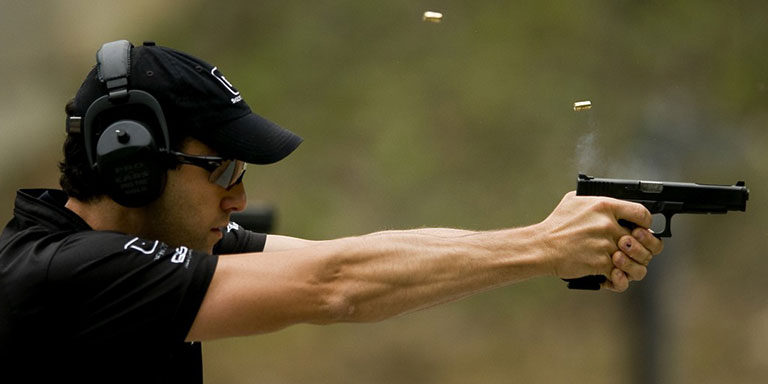
Many longtime shooters recommend breaking in rifles and pistols in a “5 x 20” pattern — that is, by firing five cycles of twenty rounds, with a thorough cleaning of the entire gun after each cycle. The moving parts in a freshly manufactured firearm are often stiff or very slightly misaligned. Repeated firing and cleaning helps these parts settle into place, at which point they'll move and reset more smoothly.
Also be sure to apply a very light coat of lubricant after each cleaning. It's important not to over-lubricate; too much lubricant can make delicate parts sticky and thus less reliable.
There's more to breaking in a gun than the gun itself; it's just as important to break in a new holster, especially if it's made of leather. Holsters that aren't properly broken in can retain (or fail to retain) your firearm at critical moments, potentially leading to a fatal disaster. Leave your new gun in its new leather holster for at least a week, then wear the holster empty for a few hours per day for another week. Repeat this process at least once more; it can take a month or two to properly form and adjust your holster. Kydex holsters can benefit from breaking in as well, but they don't need as long; a week or two should do it. Your holster is ready for daily use when you can consistently draw from it quickly and safely, with no unexpected results. It should also firmly retain your firearm whenever you're not actively trying to draw it. Always use an unloaded firearm to practice drawing and holstering. If you need help finding the right holster, our guide on how to choose a gun holster should point you in the right direction.
Finally, brand new semi-automatic magazines need to be broken in as well. Loading and unloading a new magazine twenty or thirty times might be hard on your fingers, but it's likely to help your new semi-auto feed more reliably. Repeatedly compressing and decompressing the magazine spring helps it work more smoothly and makes the magazine easier to load. However, this repeated compression and decompression is also what causes magazine springs to eventually fail, so it's important not to overdo it. Most high-quality magazine springs are good for thousands of compression/extension cycles and need only a few dozen cycles at the beginning of their lives.
How to Break In Your Rifle Barrel
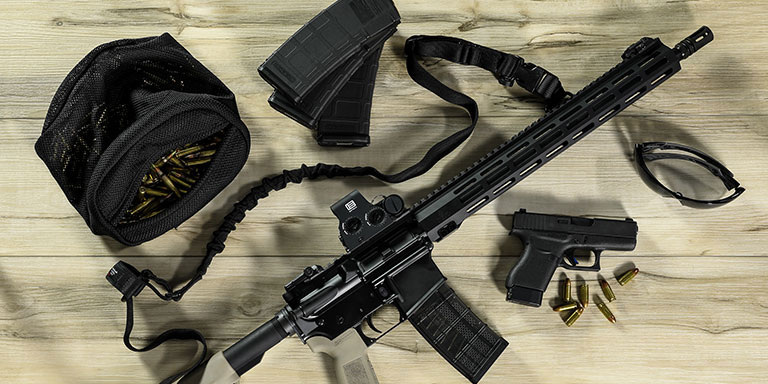
If the company that manufactured your rifle barrel doesn't offer specific guidance on breaking it in, there's a general process you can follow that should offer some benefit.
- Thoroughly clean the barrel, even if it's never been fired. You want to remove as much debris as possible, even if it's barely visible or seemingly inconsequential (like lint).
- Reassemble the rifle and fire one round.
- Thoroughly clean the barrel again and let it cool back to room temperature. Even a slightly warm barrel could reduce the effectiveness of the breaking in process, so be patient and let it cool off completely.
- Repeat steps 2 and 3 a total of ten times — twenty times if you want to be really thorough. More than twenty repetitions isn't likely to produce additional benefit.
Breaking in your handgun, rifle or rifle barrel is usually a good idea. Long-distance rifle shooters, in particular, can realize big gains from breaking in their barrels. At worst, it may be unnecessary and you might waste a few hours, but there's no risk to the firearm itself. If nothing else, it's always a good idea to spend some time firing any new gun to familiarize yourself with its handling and quirks.