

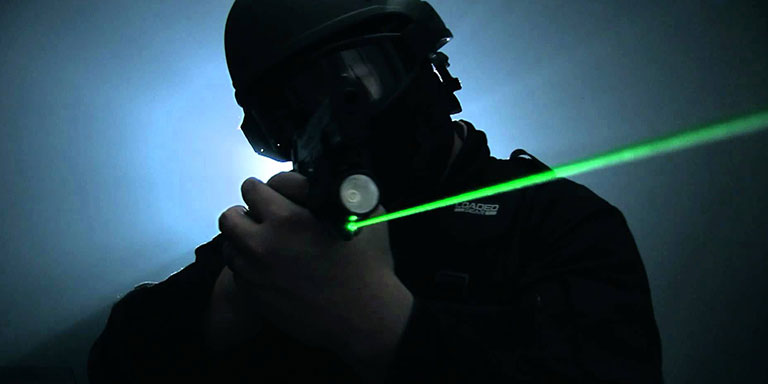
Laser sights have many helpful and practical uses. They're great for assisting new shooters in getting a feel for their weapon's sighting system and can help to sharpen overall accuracy. They can help even advanced marksmen shoot more quickly and accurately in self-defense scenarios where speed and precision are paramount. Like most other kinds of shooting equipment, laser sights have many factors that you should weigh carefully before buying. In this guide, we'll cover the advantages and disadvantages of several types of laser sights, beam colors, mounting systems and operation modes.
Good Reasons to Use a Laser Sight
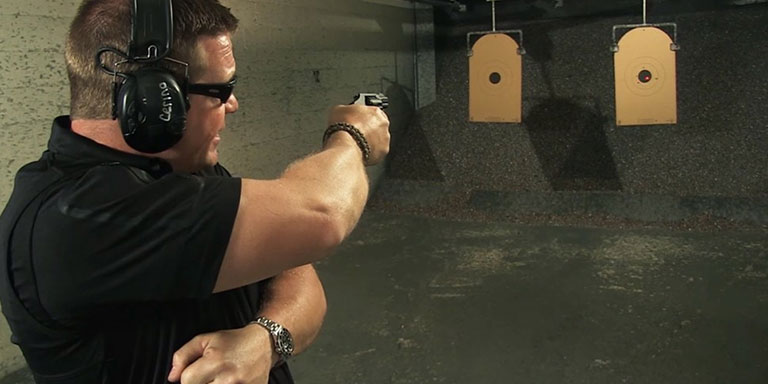
Laser sights bring a lot to the table. Most obviously, they enable you to acquire a target more quickly and land follow-up shots more accurately. They also make it much easier to fire accurately from less-than-ideal positions, like leaning around a corner.
Dry-fire training is easier and more effective with a laser sight. The movements of the dot can help you see if your breathing, grip or trigger squeeze need adjusting. Laser-light combos are great for night shooting and can make your personal defense weapon more effective in dark areas.
Laser sights also have an intimidation factor that can help de-escalate a conflict before lethal force becomes inevitable. Some studies suggest that aggressors surrender more often when they notice the telltale red or green dot on their chest.
Reasons You May Not Want to Use a Laser Sight
Of course, laser sights do have some drawbacks to consider before buying one. They require calibration and occasional recalibration, much the same way rifle scopes need to be zeroed. They use batteries that must be changed regularly and they're vulnerable to moisture, extreme temperatures and impact damage.
Adding a laser or light to your weapon makes it bulkier and heavier (especially pistols). In many cases, your sidearm will no longer fit your current holster and you'll have to buy a new one designed to accommodate laser sights. The extra weight will affect your weapon's handling and you'll need to get used to the difference.
It's also worth noting that lasers travel in a perfectly straight line, but bullets don't. In general, bullets rise slightly after leaving the barrel, then begin to drop. At ranges less than 50 meters or so, these elevation changes are usually negligible, but if you'll be using your laser sight for high-precision or long-range shooting, know that the dot will not necessarily be the bullet's actual point of impact.
Laser sights can be an excellent and helpful tool in your shooter's toolbox, but take care not to become overly reliant on them. Always remember that a laser sight is a supplement to your basic shooting fundamentals, not a replacement for them.
Laser Sight Mounting Options
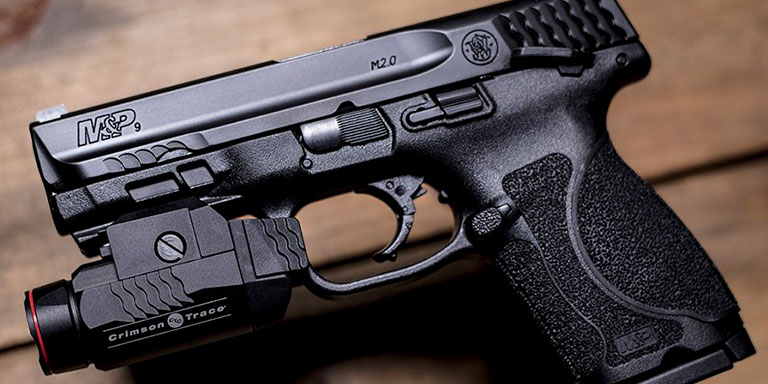
There are five main styles of laser sights with respect to how they attach to your weapon.
Underbarrel lasers - These are the most common, especially for handguns. They attach to Weaver or Picatinny rails and you may need tools to adjust them. They tend to be very stable and aren't as prone to being knocked out of alignment by recoil as some other types. However, they almost always necessitate a new holster. Shop Holsters
Grip-mounted laser sights - These lasers attach to (or replace) the grip of your weapon and are activated by pressure. They usually don't require a new holster, but the add-on types are more easily knocked out of alignment. Replacement models are more stable but aren't as widely available.
Guide rod (or internal) lasers - This type of laser replaces the guide rod and sits inside the recoil spring of your semi-automatic pistol. They're exceptionally stable and easy to activate by pushing in the new takedown lever that comes with each model. They're the most accurate laser sights for pistols because the laser's point of origin is closest to the barrel. Guide rod lasers are also highly resistant to impact damage, but on the downside, they tend to be quite expensive.
Trigger-guard mounted laser sights - These are a great option for pistols that lack rail mounting systems and for which internal lasers aren't an option. They're less stable than either but easy to install and comparatively inexpensive. You may or may not need a new holster.
Rear-sight laser sights - Rear-sight lasers either replace or attach to your existing rear sights and can be easily activated as you draw the weapon. They're generally stable, but some shooters find the odd shape distracting when trying to aim down the sight.
Red vs. Green Lasers
Visible laser sights come in two colors: red and green. Each has pros and cons, and the differences are more pronounced than you may think.
Red Laser Sights
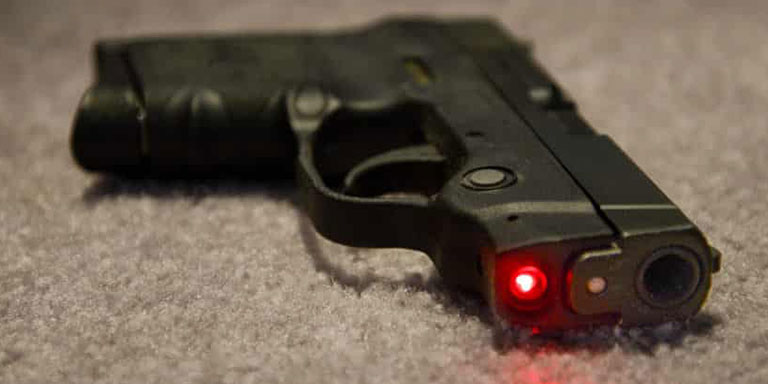
Pros
- Better battery life
- More affordable
- Less prone to failure in extreme temperatures (below 40°F and above 100°F)
- Components are more resistant to impact damage
Cons
- Less visible in bright light
- Harder to see at distances greater than about 30 meters
Green Laser Sights
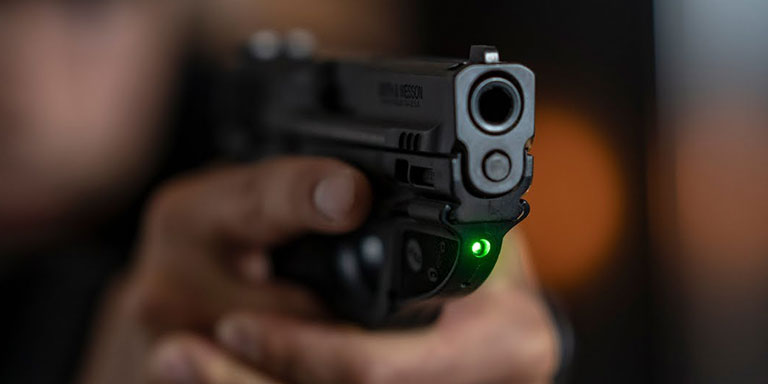
Pros
- Easier to see in bright light and at long range
Cons
- Less resistant to heat, cold, and impact damage
- More expensive
- Shorter battery life
Although it may seem that red lasers are clearly the better choice, visibility is an especially important consideration that shouldn't be overlooked. Most self-defense situations occur at night or in otherwise dimly-lit areas, so if you're shopping for a laser for your CCW gun, a red one may be sufficient. However, if you want to be sure that you'll always be able to see the laser, a green one may be the best bet, even in light of their more numerous shortcomings.
Infrared Lasers
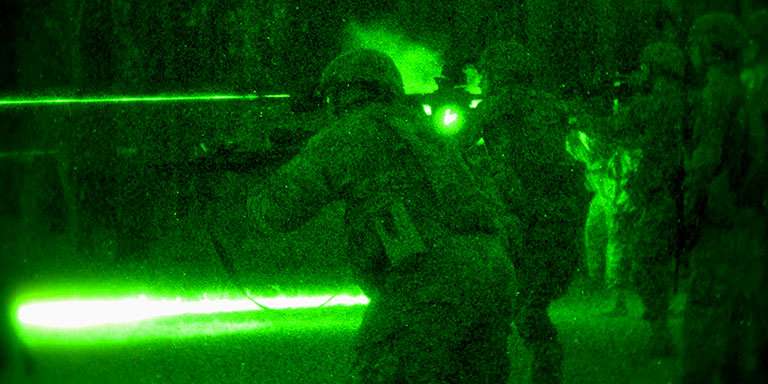
Visible lasers aren't the only kind available; there are also invisible ones. Infrared lasers can't be seen by the naked eye; they show up only with the aid of night-vision gear. IR laser sights are fairly niche and generally useless for most applications outside of military and law-enforcement night operations. However, certain civilians such as night hunters may find them useful.
Laser Sight Operation Modes
Laser sights can generally be operated in one of three modes (although not all models support all three modes): always-on, momentary-on and pulse.
Always-on (or continuous operation) mode is just what it sounds like: the laser stays on until you turn it off. Most (if not all) laser sights have this mode, which is suitable for most training, police, military and self-defense operations.
Momentary-on mode is often useful for hunters, police snipers and other shooters who don't want the target to get spooked when they notice the laser. Upon activation, the laser turns on for a brief moment, then shuts off. This also enables the shooter to confirm that they're on target immediately before taking a shot.
Pulse mode rapidly and intermittently turns the laser on and off. Its primary advantage is that it conserves battery life more efficiently than continuous mode. This can extend the typical battery life of a red laser from 4-5 hours to 10-12 hours.
With proper use and regular training, laser sights can be a valuable aid to any shooter. From hunting to training to personal defense, there's almost no task they can't make easier and more effective. A laser sight well suited to your needs and preferred weapon definitely can be a worthy investment.