

Share:
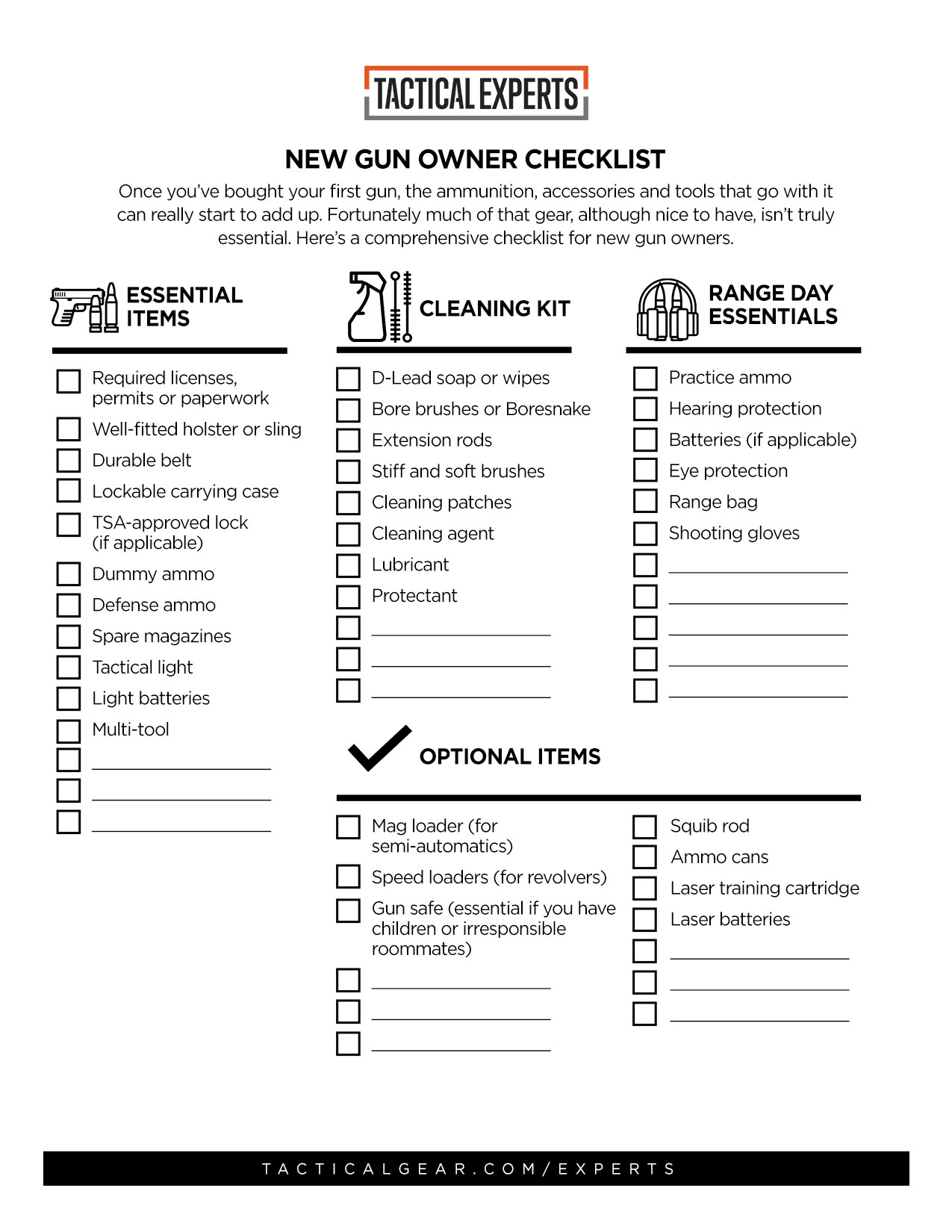
New Gun Owner Checklist: Everything You'll Need
A safe, high-quality firearm isn't cheap — you're looking at about $350 for basic shotguns and rifles and $600 or more for pistols. Before you go shopping, make sure you've got enough money set aside to buy all the other essential items you'll need aside from the gun itself.
Essential Items
Some gear is nice to have, but other gear is pretty hard to go without. Whichever weapon you buy and whatever you plan on using it for, you'll want to make sure you have these basic essentials.
Required licenses, permits or paperwork: In most states, you need a permit to carry a weapon, and in some states, you need a separate license to buy one. Get clear on your local laws and have all your paperwork in order before you do anything else.
Well-fitted holster or sling: It may be tempting to buy a cheap, universal holster, but you'll likely regret it. A high-quality holster crafted for your specific firearm will last much longer and retain your weapon more securely. For shotguns and rifles, a sturdy sling serves the same purpose.
Durable belt: You don't necessarily need to wear a tactical or duty belt everywhere you go (although it's not a bad idea). A decent leather belt will do if you intend to carry your handgun on your waist.
Lockable carrying case: If you fly a lot, a carrying case with the lock built in is worth the investment. Virtually all ranges require firearms to be in a case or holster until you reach the firing line, so you'll likely want a case for that purpose, too.
TSA-approved lock (if applicable): The TSA has specific (and inconsistently enforced) requirements for firearm locks that aren't integrated into the case. If you need a separate lock, check the TSA website and choose a lock that clearly meets all of their requirements.
Dummy ammo: One of the best and safest ways to become comfortable with your new gun is to practice handling, cycling and operating it with training rounds (inert plastic bullets).
Defense ammo: Do some careful research on the various types of ammunition and pick up a box of high-quality personal defense rounds that suit your purposes. Although defense rounds are more expensive, it's worth firing at least a few boxes of your chosen brand at the range to get used to it — different brands and types of ammunition perform differently.
Spare magazines: Three total magazines is a good number for beginning shooters who choose a semi-automatic firearm. Unless you're on a very tight budget, buy official magazines from the same manufacturer who made your gun. Aftermarket magazines may be cheaper, but they are often of lower quality and thus more prone to failure.
Tactical light: For most shooters, a high-quality standalone or attachable tactical light is the only firearm accessory that's truly essential. If your gun is primarily for home or personal defense, you'll definitely want to be able to see clearly in dark areas.
Light batteries: Of course, a light isn't much good without batteries. Some tactical lights use special batteries that may be less widely available, so be sure to always have one or two spares on hand.
Multi-tool: At some point, you'll need to adjust your sights, manually extract a jammed casing, or make other minor tweaks and repairs to your gun. A basic multi-tool is space-efficient and can handle most of these tasks.
Cleaning kit
Keeping your new gun clean and in good repair is absolutely essential to being a safe and responsible gun owner (make sure to read our guide on gun cleaning and maintenance basics). For your first gun, it's easiest to buy a complete cleaning kit that contains all of these items.
D-Lead soap or wipes: Firing a gun leaves gunpowder on your hands and face — gunpowder that contains lead and other substances that are harmful if absorbed through your skin. Pick up some soap or wipes designed specifically to remove these substances.
Bore brushes or Boresnake: Bore brushes are caliber-specific wire brushes for cleaning the first layer of crud off your weapon. Boresnakes are bore brushes attached to cords for easier passage through the barrel.
Extension rods: These metal rods come in short segments that can be screwed together. Attach cleaning patches to them to clean the inside of the barrel and other hard-to-reach areas.
Stiff and soft brushes: Like bore brushes, general cleaning brushes are good for the first round of cleaning. The bristles are typically stiff, gold or copper-colored wire. Softer nylon brushes are good for more delicate cleaning tasks.
Cleaning patches: Small cotton patches, in combination with a cleaning agent, are for removing grease and gunpowder.
Cleaning agent: Solvents and degreasers are used to remove especially stubborn grit, grease and carbon to get your firearm back to like-new condition.
Lubricant: A light coat of lubricant on surfaces that move past one another helps your weapon cycle more smoothly, and thus more safely and more reliably.
Protectant: Protectants aren't always necessary, but they can help protect your gun from rust, especially if you live in a humid climate.
Range Day Essentials
Eventually, you'll want to test your aim out with your new weapon of choice. When you plan on heading out to the range, make sure you take these items along with you. For more in-depth range day advice, take a look at our range day checklist and some shooting drills for beginner marksmen.
Practice ammo: Once you feel ready, head to your local range and practice with some inexpensive (but not too inexpensive) ammunition. Be especially wary of steel-case ammunition, as it can scratch your firearm and is generally more prone to malfunctions. Brass ammunition is best for a majority of shooters and firearms.
Hearing protection: Most shooting ranges require hearing protection, but even if yours doesn't, a good pair of earplugs and/or headphones is still indispensable. In some cases, even a single gunshot can cause permanent hearing damage without proper protection.
Batteries (if applicable): Electronic earmuffs are capable of dampening sounds above a certain decibel threshold while amplifying sounds below that threshold, meaning you can still hear people talking to you even with gunshots in the background. Most models can run for 5-10 hours on standard AA batteries.
Eye protection: Eye protection is less critical than hearing protection, but it's still pretty important. In rare cases, flying brass can cause moderate eye injury, and in the exceedingly rare event of a catastrophic malfunction, you'll definitely want a barrier between your eyes and your weapon. Make sure you pack some shooting glasses.
Range bag: A standard gym tote will work fine for a basic range day, but range bags have compartments and pockets designed to keep your weapon, ammo and accessories organized and secure.
Shooting gloves: Even experienced shooters can get blisters and cuts on their hands after a long day at the range. Shooting gloves are designed to protect your hands without significantly limiting your dexterity. If you need help finding the perfect pair, take a look at our guide on how to choose shooting gloves.
Optional Items
These items aren't necessarily essential, but they'll make for a much easier and complete gun owning experience. Here's some of the extra gear we think you should consider.
Mag loader (for semi-automatics): Some people find it difficult or painful to load magazines manually and will appreciate a simple mag loader that makes the task faster and less unpleasant.
Speed loaders (for revolvers): Reloading revolvers quickly is a skill all its own. Speed strips and moon clips enable novices to get their wheelguns back in action more quickly than loading rounds one by one.
Gun safe: A well-made safe may be a luxury if you live alone, but it's essential if you have children or irresponsible roommates. If there's any chance of someone getting ahold of your gun without your permission, shut down that possibility by investing in a safe.
Squib rod: A "squib" is a rare but dangerous malfunction in which a bullet becomes lodged in the barrel of a gun. A squib rod is a tool designed to dislodge such bullets safely. If you practice at a range, the employees will have a squib rod somewhere, so you don't necessarily need your own.
Ammo cans: If you only own a few boxes of ammo, it's usually fine to store the bullets in their original cardboard containers. Once you own several hundred rounds, though, a steel ammo can is an inexpensive and effective way to protect them from the elements. Add a desiccant packet for extra defense against moisture.
Laser training cartridge: These bullet-shaped training aids are inserted into the chamber of your firearm and briefly emit a laser when you squeeze the trigger. This makes dry-fire training more effective because you can see the exact point of impact.
Laser batteries: Laser training aids typically use special batteries, but they're fairly inexpensive and usually last for several months of regular use.