

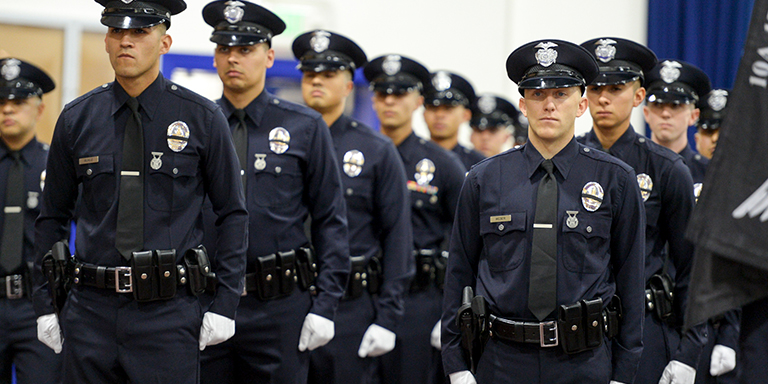
Police academy training has changed quite a bit over the years, but the goal remains the same: to protect and serve the public. In this article, we'll take you through the present-day police academy experience. We'll outline the educational curriculum at the academy, the physical fitness standards and more to better understand how police officers prepare to protect and serve.
We'll also take a look at police training procedures of the past and how they've changed over time as a response to the relationship between citizens and law enforcement. Finally, we'll consider the future of police training and how political and socioeconomic factors may affect its course. If you're interested in entering a police academy, take a look at our guide on how to become a police officer.
Daily Life at the Academy
Police officers begin their training as recruit officers at the academy. There are two types of academies: residential academies, where recruits live Monday through Friday, and daily-attendance academies, where recruits live at home and commute to the academy. Daily-attendance academies are the more popular (and cheaper) option of the two. A typical day at a daily-attendance academy usually goes as follows.
The recruit wakes up by 5 a.m. and dresses in a clean, neatly pressed uniform by 6 a.m. Their shoes and belt must be polished to a mirror shine. A male recruit's head must be cleanly shaved, and all facial hair should be shaved, too. Recruits report to the academy by 6:15 am. and change for physical training.
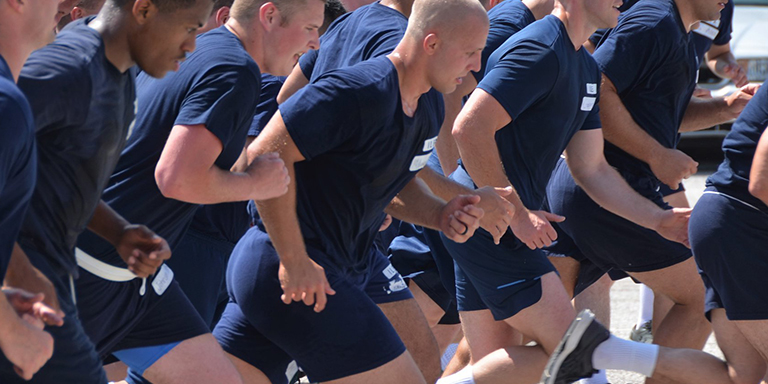
Physical training consists of both strength and endurance training. Recruits run every day and complete stretching exercises, followed by calisthenics for one hour. They'll then shower and prepare for inspection at 7:30 am. They'll be looked over at 7:45 am and be penalized for any flaws in their uniform or appearance. Recruits should expect regular inspections during the early weeks of their training. Any punishments will have to be worked off with special duties.
The academy class will then complete a military-type drill in which they'll learn proper formation, turning in unison, opening and closing ranks, and marching. After drill, the academic day begins, with various instructors teaching lessons while recruits take notes in a classroom setting. After several hours of classroom instruction, recruits take a break for lunch. Following lunch, several more hours of instruction are provided.
At 4:30 p.m., instruction concludes, and the last half hour is spent cleaning and vacuuming the classroom. Returning home by 5:30 p.m., a recruit's homework consists of copying that day's notes into a finished notebook (which is later reviewed and graded). They then spend time preparing a fresh uniform and re-polishing their shoes and any other leather gear. After dinner, it's time to collapse into bed, anticipating doing it all over again early the following morning.
Note: During the recruit's day, military-type discipline is enforced. This includes coming to attention when an instructor enters a room, standing at attention and saluting all instructors, and responding to questions with "sir" as the first and last words of any answer.
Accelerated Learning
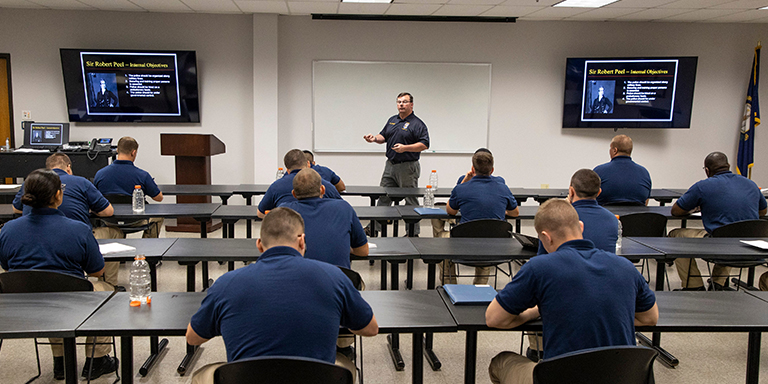
Police academies are relatively short in duration — usually eighteen to twenty-four weeks. However, recruits have to learn a massive quantity of information and tactics before graduation. The volume of information presented could be compared to two year's worth of full-time college study.
Curriculum and the quality of instruction are important factors in determining the caliber of the officers who graduate. Police academies are a cross between military boot camps and college classes. On the military side, instructors must teach military-style discipline, including drill (marching, standing inspections and following orders) and survival skills, including hand-to-hand combat, tactical training and firearms training.
On the academic side, a police recruit must complete months of classroom learning and testing. The subject matter includes criminal law, motor vehicle law, courtroom procedures, report writing, interviewing techniques, first aid and many other topics.
Curriculum
The curriculum is the lifeblood of any academy. It is set by a governing authority, such as a statewide police training commission or another authorized group. It's up to this group to determine what police recruits must learn and in which skills they must demonstrate proficiency. Unfortunately, some of these experts are, in reality, political appointments or union representatives instead of law enforcement professionals with hands-on experience.
Several forces have guided changes in the police academy curriculum. Historically, these have included the passage of new laws and the decisions of both state and federal Supreme Courts. However, more recently, curriculums have been altered to address specific, high-profile cases involving a police officer's use of force, police tactics and the public's changing attitudes toward the police.
Changing What Has Not Worked
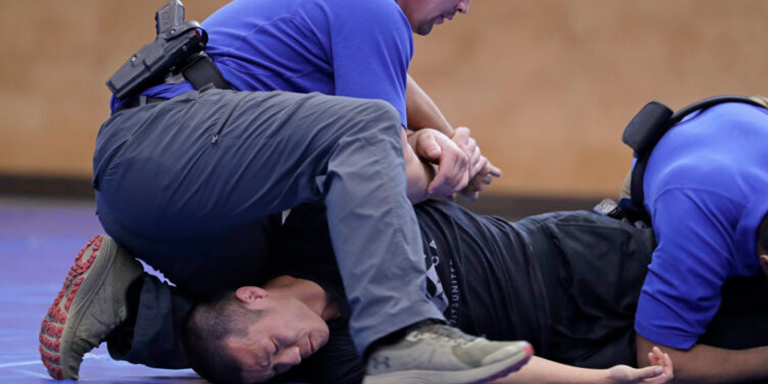
Academies taught the use of chokeholds (or sleeper holds) in the past to control a fighting suspect from behind. Recruits were taught to lock their forearm across a suspect's neck, closing their windpipe to stop resistance. Over a period of time, it was determined that if too much force was applied, the windpipe could be crushed and, in extreme cases, the suspect could die.
The hold was then altered from force against the windpipe to force against both carotid arteries, blocking blood flow to the brain. This involved placing the officer's elbow below the windpipe and using the upper and lower arm to constrict the carotid arteries. Unfortunately, this also became potentially deadly, and constricting holds around a suspect's neck are no longer taught or authorized by departments.
This is not to say that if an officer is fighting for their life, they cannot use whatever means necessary to stop the threat. Still, the techniques are no longer taught or authorized to control suspects and will, in many jurisdictions, be viewed as a deadly force technique.
Another tactical change came in response to positional asphyxiation. This occurs when a person cannot breathe because of their positioning. The most common example is keeping a handcuffed person on their stomach for a significant period of time, with a police officer placing their weight on the arrestee's back. While it is still often necessary to position a resisting arrestee on their stomach to be handcuffed behind their back, they should not be kept in this position for long.
Changing Expectations
It is essential to understand that police officers and departments are answerable to those who write the rules (legislators) and those who control the purse strings (political leaders). Both of these groups are elected and, therefore, answerable to the public. Therefore, as public opinion changes, so do the laws that control police officers' behavior.
Take the example of marijuana. People were arrested and placed in jail for possessing or using marijuana for years — the odor of the substance alone was all that was needed to search a car in many states. Now, most of the public has decided that marijuana should either be legal, medically legal or decriminalized. Only Idaho, Wyoming and South Carolina consider marijuana entirely illegal. In addition to changing laws brought about by public pressure, police training must also address public opinion and public perceptions.
Communication Is Key
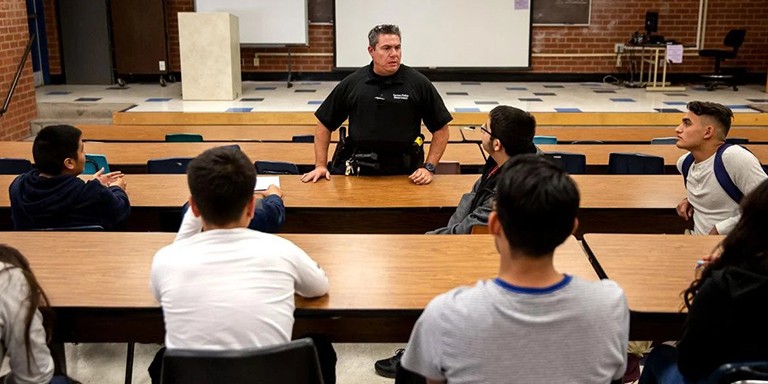
Police training commissions must act quickly to address changing public attitudes, in particular the problem of officers lacking in persuasive communication skills. Part of the solution includes learning how to communicate effectively with children, teens, the elderly, people in crisis and people with special needs. Communication also is critical in the de-escalation process.
Police academies should allocate less time for learning criminal statutes and more time to communicating effectively. This process must be heavily weighted toward performance in mock scenarios. Recruits should practice public speaking and conflict resolution daily while in the academy, and those who do not possess and cannot master communication skills should not graduate.
While some of the old ways (like chokeholds) are gone, other old-time practices are being brought back. For example, the classic concept of walking a beat and knowing the people in your assigned neighborhood on a personal level was good. The people in the community trusted their officers and would even come to their aid in many cases.
When police were all assigned to cruisers, they became anonymous authority figures who showed up to react to all types of disorder, conduct car stops and make arrests. This accounted for many of the negative feelings individuals continue to harbor. Much of the blame for this shift has to do with police budgets; after all, walking patrols and community-based policing are expensive. As a result, many police are viewed as unsympathetic, uniformed figures showing up to order people around. Communication skills are paramount in correcting this perception.
Continuing Education
Police academies are changing what and how they teach to be effective in today's society. But what about the officers with fifteen or more years on the force? Today's policing is not the same as what they learned in the academy. Can a few hours of in-service training completely change the mindset of a veteran officer, or is a longer, academy-based refresher course necessary? It's hard to say, but there is a good argument out there for continuous supplemental training.
Warrior or Guardian?
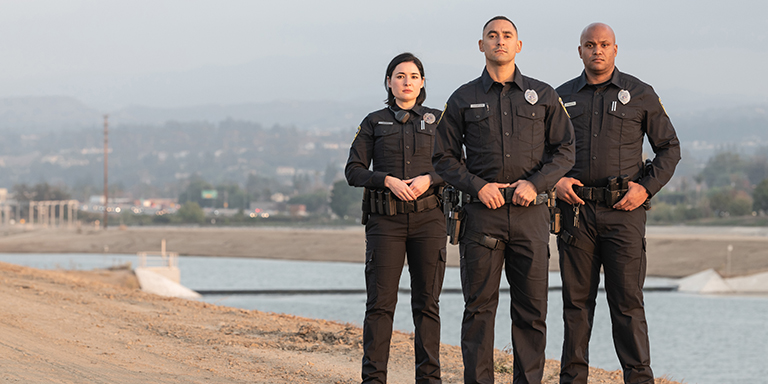
Police officers are expected to be warriors who fight violent criminals, bust up drug gangs and stop gunfights in the street. At the same time, they're supposed to be guardians of the communities they serve by fairly resolving disputes and winning the public's trust. This balance is a difficult stretch for even the best police officer.
America has to decide what they want their police to be, because they cannot be all things to all people. They cannot be social workers, mental health experts, drug treatment specialists and family guidance counselors while fighting crime on top of it all. It's simply too much responsibility.
America must decide if they want law enforcement officers to enforce laws first and foremost, or become peace officers who respond to every type of incident looking to arbitrate equitable solutions. Once America decides, police academies can adapt to the evolving job description and adequately train recruits.
In today's society, the public has learned that it has a voice in shaping the future of policing in the United States. Sometimes the public's ideas on what police work should look like clash in heated debates or even all-out brawls. The idea of defunding the police gets pitted against the idea of enforcing law and order. At the end of the day, though, most of America still values police officers and recognizes the important work they do in keeping communities safe. As time goes on, police training mandates will evolve to reflect and enforce those values.