

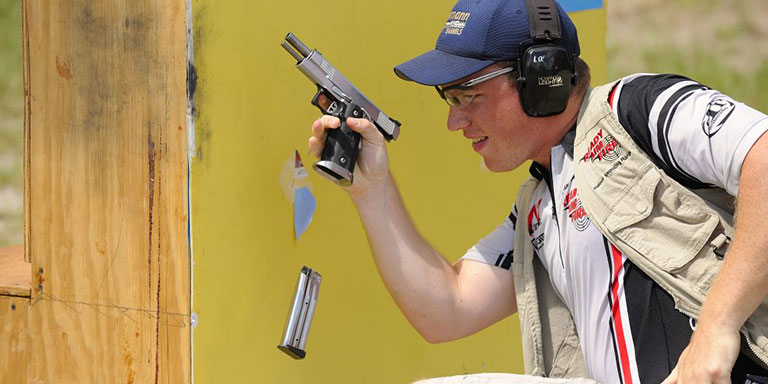
Unlike most other competitive shooting sports, International Defensive Pistol Association (IDPA) events challenge shooters with scenarios meant to resemble real-world self-defense situations. If you're looking to have fun, compete in high-adrenaline matches and improve your defensive shooting skills all at the same time, this could be the sport for you.
In this guide, we'll introduce the terminology and scoring systems particular to IDPA matches, summarize the different divisions, review equipment requirements and offer some tips on getting started.
Acronyms and Terminology
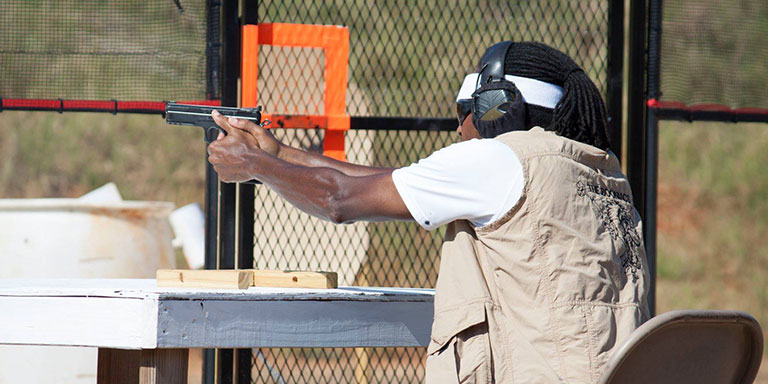
If you visit the IDPA website with no previous knowledge of the sport, you may be confused by the jargon and acronyms. Don't worry, though — there isn't nearly as much new language to learn as you might encounter in other shooting sports.
Shooter Ranks
These acronyms are used to refer to IDPA members by their skill and experience level, as determined by classification tests.
A new member or guest who has not yet completed an official classification test is referred to as "unclassified" (abbreviated UN). Higher ranks, in ascending order of proficiency, are novice (NV), marksman (MM), sharpshooter (SS), expert (EX), master (MA), and distinguished master (DM).
Scoring Acronyms
There are a few acronyms to know before you'll understand what match referees and other competitors are talking about. We'll go into more detail about what these terms mean a bit later.
PD: Points down
TPD: Total points down
DNF: Did not finish
PE: Procedural error
HNT: Hits on a non-threat
FP: Flagrant penalty
FTDR: Failure to do right
Match Divisions
Depending on what kind of gun you want to compete with, you'll be grouped into one of eight divisions. Some guns are legal in multiple divisions, and some division requirements are more strict than others. Here's a brief summary of the divisions:
Stock Service Pistol (SSP): This great entry-level division allows virtually all full-size service pistols chambered in 9mm or larger, but most modifications are prohibited. Magazine capacity is limited to 10+1.
Enhanced Service Pistol (ESP): Basically the same as SSP but with a much greater range of allowed modifications. Magazine capacity is the same.
Carry Optics (CO): If you want to use a pistol with any kind of optic or laser, you'll need to compete in this division. The official rules are simple: aside from optics, guns must meet the same requirements as those in the ESP division.
Custom Defensive Pistol (CDP): In practice, this is basically a 1911-only division. All guns must be chambered in .45 ACP with a maximum capacity of 8+1.
Compact Carry Pistol (CCP): Guns in this division must be at least 9mm, but only compact and subcompact frame sizes are allowed. Magazine capacity is capped at 8+1.
Back Up Gun (BUG): These guns must be even smaller than CCP guns. The minimum caliber for this division is .380 and capacity is 5+1 for semi autos or 5 for revolvers.
Revolver (REV): As you might expect, this division is for wheelguns only. Allowed calibers include .38 Special, .45 ACP, and 10mm. Maximum capacity is 6 rounds.
Pistol Caliber Carbine (PCC): This is the closest you'll get to a rifle division in IDPA sports. Caliber must be at least 9mm and the maximum magazine capacity is 30.
In addition to these requirements, competition guns must be within certain size and weight limits. You can find up-to-date specifications in the IDPA rulebook (note — if this link doesn't seem to reflect the most up-to-date version of the IDPA's rules, you can check the Resources tab on the IDPA homepage for the latest version).
IDPA Match Scoring
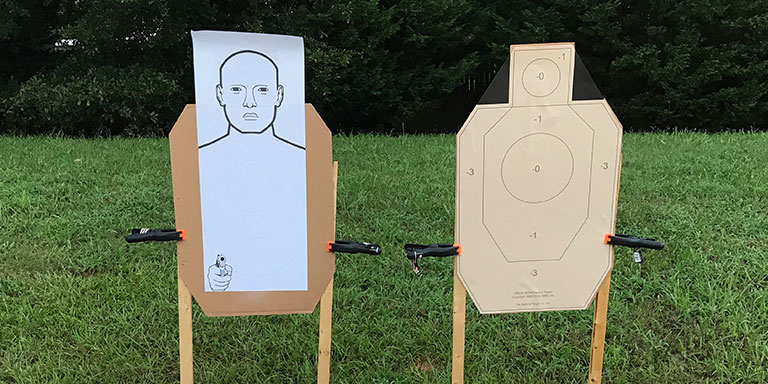
Unlike most competitive shooting sports (like metallic silhouette shooting or trap and skeet shooting), wherein the goal is to score the maximum number of points, IDPA shooters strive to finish the course as quickly as possible. The winner is the competitor with the lowest time after any penalties are applied.
IDPA matches are run on courses designed to mimic various real-world combat scenarios. In most cases, you'll be required to move to a specific position, engage multiple targets from behind cover, then move to another position and engage new targets. You're generally required to hit each target twice, and there are rules about reloading as well. You can perform speed reloads only if your magazine is empty. You must retain any magazine that still has rounds in it.
There are two main types of scoring: limited and unlimited. In limited scoring matches, you may only fire a certain number of shots at each target, and your two worst hits will be scored. Unlimited scoring allows you to fire any number of shots at a target, and your two best hits will be scored. Of course, the downside of firing more shots is that it takes more time, so in unlimited matches, you must constantly weigh the benefit of cleaner hits against the risk of taking too long to finish the course.
Targets are marked in three zones. The central head and vital organs are "down zero" zones. "Down one" zones are those slightly outside of down zero zones but still within vital areas. All other zones on the target are "down three" zones, and if you miss the target entirely, that's a "down five" shot.
For each point down, one second is added to your final time. For example, if you finish the course in 20 seconds with two down three hits, your final time is 26 seconds.
Additional penalties may be assessed if you fail to move or shoot correctly. The two most common (and least severe) penalties are procedural errors (PEs) and hits on non-threat targets (HNTs). Every HNT is a down five. PE penalties are a bit more subjective, and they can vary in magnitude. Basically, a PE penalty is applied when you do something you weren't supposed to do (excluding blatant cheating). Shooting targets out of order, leaving ammo behind or leaning too far out of cover are examples of things that can incur PE penalties. Before every match, the range master will explain the possible PE penalties for that course and how to avoid them.
Flagrant penalties (FPs) are assessed only when you break the rules repeatedly or in a significant way. Importantly, this penalty is not for safety violations or outright, intentional cheating; such behavior would incur a failure to do right (FTDR) penalty, the worst of all. A FTDR penalty adds 20 seconds to your time and virtually guarantees that you will finish last in the match, and repeated FTDR violations may incur temporary or lifetime bans.
Holster Restrictions
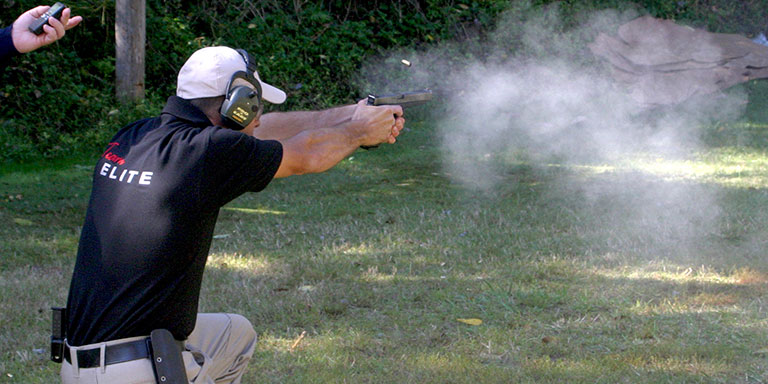
There's another way in which IDPA matches are different from most other competitive shooting sports: you're not only permitted to quickly draw and fire from a holstered position, you're required to do so. Additionally, your holster and weapon must be fully concealed at the start of each match. After all, the whole sport is designed to prepare shooters for real-life self-defense situations.
Whatever holster you choose, it must be worn in what is considered a "normal" position for that holster (for example, you can't wear a right-handed holster on your left hip). It must retain the firearm securely and be attached to an IDPA-compliant belt. Depending on the division, you'll be required to orient the holster somewhere between 2 o'clock and 4 o'clock (or 8 o'clock and 10 o'clock for lefties). Cross-draw holsters, shoulder holsters and pocket holsters, among others, are banned for safety reasons.
These are the basic requirements for holsters, but there are quite a few others to be aware of. Consult the IDPA rulebook and check with your local club to make sure your gear is compliant before signing up for your classification test.
Tips for Getting Started
IDPA shooting is a fairly inexpensive sport, at least compared to some others. The list of gear you'll need is short:
IDPA-legal firearm (be sure you know the divisions in which the firearm is legal)
At least two belt-worn magazine pouches
At least three magazines, speed strips, or moon clips
A pair of shooting glasses and ear protection
Clothing that completely conceals the firearm when worn normally
3 Essential Tips for Beginners
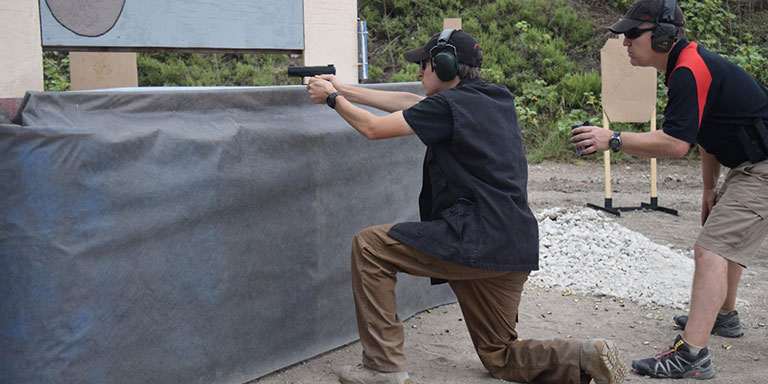
We've come up with three suggestions that we think will be most helpful when you're just getting started with IDPA events.
Practice accuracy and correctness first, then speed. Because IDPA shooting is all about speed, it's tempting to move and shoot as quickly as possible, right off the bat. But no matter how fast you are, speed won't matter if you can't navigate the course properly and hit all of your targets with precision. As they say, slow is smooth and smooth is fast. Practice navigating the course slowly, aim your shots carefully and become thoroughly familiar with IDPA rules about cover, reloading and movement. Once you've got all that down, then you can worry about trying to do it quickly.
Pay special attention to IDPA safety rules. Because competitors are moving quickly while carrying loaded weapons and doing rapid holster work, safety is even more important than in other shooting sports. Safety violations are the most common reason for new members to be reprimanded or banned. Never sacrifice safety for speed, and if necessary, talk with the range master to be sure you fully understand what's expected of you.
Don't neglect the social aspect of IDPA events. Most members are friendly and more than willing to help you learn. Actively seek out a mentor (or several) at your local club. You'll improve more quickly and have more fun when you take advantage of their expert guidance.
IDPA shooting is one of the most fun, rewarding, and useful shooting sports out there. Not only will it improve your reflexes and marksmanship, it's arguably the best and most cost-effective training option for civilians who want to prepare for real self-defense scenarios. Most cities of any significant size have at least one IDPA club somewhere nearby, so give it a shot (pun intended).