

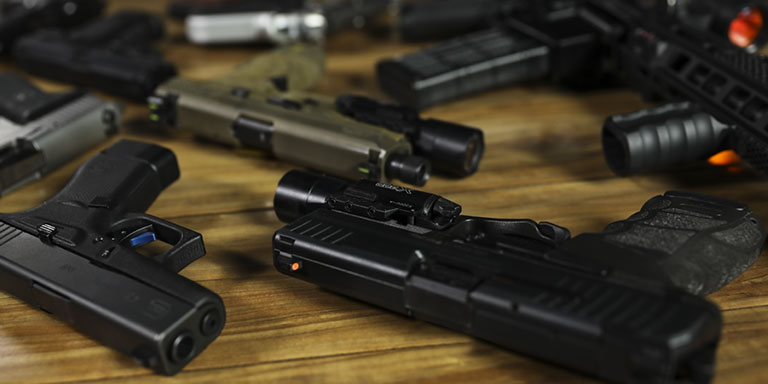
Guns are a sensitive topic (perhaps now more than ever), and it's critical for journalists who write about them to be well-informed. Media outlets often publish gun-related content that is poorly researched (or not researched at all), which damages the credibility of the company and of the journalists who created the content. Factually inaccurate content also damages the public's trust in the media.
In this guide, we'll review some basic facts about guns and offer tips for writing or speaking about them objectively. We'll also present and correct some of the most common misconceptions about guns and violent crime.
Guide to Gun Terminology and Definitions
As a journalist, the words you choose to use and how you use them are tremendously important. The golden rule of journalism is to be objective, but the actual meaning of “objective” has become increasingly distorted in recent years. Many people today think that being objective means treating all sides of an issue as equally valid, but this is actually non-objective; two or more opposing positions can't all be true at the same time. One position is right and the others are wrong (or, frequently, all popular positions are wrong). To be objective is to report only the facts, to support them with reliable sources and to admit when you aren't able to draw a well-supported conclusion.
One of the most basic and most important considerations when it comes to being objective about guns is to know the relevant terms and to use them correctly. Today, many gun-related terms are meaningless, misleading or, worst of all, used to advance a political agenda rather than to report the facts accurately. Here's a non-exhaustive list of terms you're likely to run across when reporting about guns.
- Assault weapon: At best, describing a firearm as an “assault weapon” is not helpful to the reader, and at worst, it's meaningless or misleading. Even under the broadest (and least accurate) definition of “assault weapon,” such weapons are used in less than 1% of crimes involving guns. In modern usage, this term is a politically-charged one often meant to emotionally manipulate the reader rather than to inform them. For this reason, and because most firearm experts generally agree that the term doesn't really mean anything, it's usually best to avoid it entirely. Also, the “AR” in AR-15 stands for ArmaLite (the original manufacturer), not “assault rifle” or “automatic rifle.” AR-15-style rifles are, by definition, not capable of automatic fire. When describing a firearm, use simple terms like “rifle,” “handgun” or “shotgun.”
- ATF: The Bureau of Alcohol, Tobacco and Firearms, which enforces most firearm-related laws and regulations in the United States.
- Automatic weapon or automatic fire: An automatic firearm is one that fires continuously with a single pull of the trigger. With extremely few exceptions, these weapons are not legally available to the general public (see “machine gun” below).
- Bullet: A bullet is only one part of a round or cartridge — the only part that exits the barrel when the gun is fired. Read our complete guide on ammunition here.
- Bump stock: Contrary to popular belief, a “bump stock” does not in any way make a semi-automatic gun capable of automatic fire. Bump stocks are novelty devices that make it slightly easier to repeatedly pull a trigger more quickly in short intervals (typically no longer than a few seconds). Reputable shooters and gun experts know that, if anything, bump stocks make shooters less effective and less deadly because they dramatically reduce the shooter's accuracy; they are purely entertainment items.
- Caliber: Caliber describes the diameter of a bullet in either inches or millimeters. All else being equal, larger bullets are more deadly. For handguns and rifles, larger numbers mean larger bullets. Shotgun shells, however, are measured by gauge, in which case a smaller number indicates more powerful shot. The most common pistol and rifle calibers, from smallest to largest, are .22, .25, .308, .32, 9mm, .357, .380, .38, .40, .44, .45 and .50. The most common shotgun gauges, also from smallest to largest, are .410, 20, 16, 12 and 10.
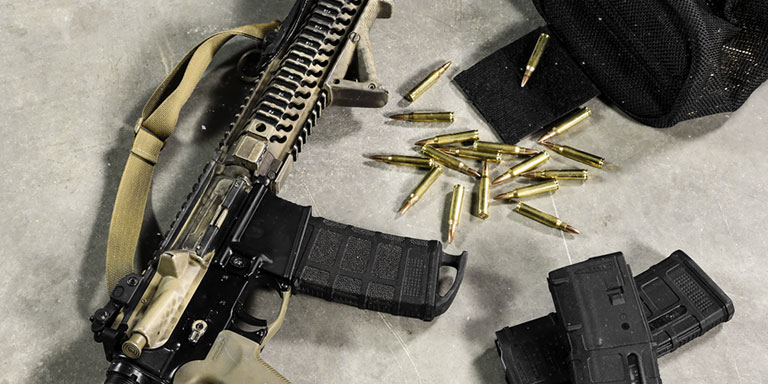
- Cartridge: A cartridge is a single unit of ammunition for a rifle or pistol (shotguns use shells). The cartridge is composed of four parts: a case (usually made of brass) that holds the other components; a bullet; gunpowder, which propels the bullet out of the barrel when ignited; and a primer, which ignites the gunpowder when struck by the gun's firing pin. Shotgun shells also contain a “wad,” a piece of plastic or fabric that separates the pellets from the gunpowder.
- Clip: Many people use the term “clip” when they really mean “magazine” (see below). A clip is a small piece of metal that holds individual bullets together to make them easier to load into a firearm or magazine. There are few firearms to which the term “clip” is relevant.
- Handgun: The simplified ATF definition of a handgun is “any weapon originally designed, made, and intended to fire a projectile (bullet) from one or more barrels when held in one hand.”
- Machine gun: A machine gun is a specific type of firearm not legally available to the general public. The ATF defines a machine gun as “Any weapon which shoots, is designed to shoot, or can be readily restored to shoot, automatically more than one shot without manual reloading, by a single function of the trigger.” In the United States, machine guns are used almost exclusively by police and military forces. The only civilians who can legally own machine guns manufactured after 1986 are class 3 firearm dealers and collectors, who must undergo extensive screening by the ATF to obtain that licensure. Even then, such licensees must obtain special permission from the government to buy or sell machine guns, and they can only sell those guns to the government or to other class 3 dealers. Civilians who undergo extensive background checks may purchase machine guns manufactured before 1986, but for the vast majority of people, the price of these weapons makes them unobtainable; they can easily cost $25,000 or more.
- Magazine: A magazine is a container made of plastic or metal into which cartridges or shells are loaded individually. The magazine is then loaded into the firearm and feeds ammunition into it until the magazine is empty. The terms “magazine” and “clip” (see above) are not interchangeable.
- Pistol Grip: It's commonly believed that pistol grips on rifles or shotguns are “military“ components that somehow make those weapons deadlier. This is not true. A pistol grip merely makes such weapons usable (or more usable) because they take into account the shape of the human hand. Firearms that lack pistol grips are (slightly) less comfortable to hold; there is no other difference.
- Rifle: The ATF defines a rifle as “a weapon designed or redesigned, made or remade, and intended to be fired from the shoulder, and designed or redesigned and made or remade to use the energy of the explosive in a fixed metallic cartridge to fire only a single projectile through a rifled bore for each single pull of the trigger” (emphasis added). This definition, in part, is why it's not correct to use “assault rifle” to describe a weapon capable of automatic fire.
- Semi-automatic: Many media outlets today use the term “semi-automatic” because, to the layman, it makes guns sound scarier. A semi-automatic firearm is simply one that fires one shot each time the trigger is pulled. The vast majority of firearms produced and sold since at least the 1950s are semi-automatic. Describing a firearm as “semi-automatic” is like saying “gasoline-powered car,” so it's usually not helpful to the reader. Read more about the history of modern firearms here.
- Shotgun: The ATF defines a shotgun as “a weapon designed or redesigned, made or remade, and intended to be fired from the shoulder, and designed or redesigned and made or remade to use the energy of the explosive in a fixed shotgun shell to fire through a smooth bore either a number of ball shot or a single projectile for each single pull of the trigger.”
For further information, see our guides on identifying the parts and function of handguns and rifles.
Common Misconceptions about Gun Laws
Federal, state and county laws concerning firearms are as complex as they are numerous. Legally speaking, buying a gun is a lot more complicated than most people think, even if much of the complexity happens behind the scenes. Allow us to dispel some common myths about gun laws.
Myth #1: You can buy guns as easily as you can buy groceries
Some retail outlets (like Walmart) sell firearms. This and other facts have led many people to incorrectly assume that anyone can buy a firearm with minimal government oversight. In reality, the process of buying guns is heavily regulated and monitored by a highly accurate background check system, regardless of whether you're buying at Walmart or a local gun store. Many journalists have tried to buy guns from retailers as a way of proving how easy it is, only to discover that there are, in fact, strict legal safeguards in place.
Myth #2: It's easy and common for guns to be bought and sold without background checks
Like many myths, this one started with a grain of truth and snowballed out of control. In some states, it is legal for private citizens to sell guns to one another without conducting background checks, whether independently or at gun shows. However, there are many other relevant facts to consider:
- More and more states are passing new laws requiring background checks for all gun sales. As of 2021, twelve states require background checks for all gun sales and a further six require them for handgun sales. These eighteen states currently account for nearly one third of the entire population of the United States.
- Many gun shows (likely a majority of them) require background checks for all sales, even if state law doesn't.
- Some studies suggest that roughly 70% of private sellers conduct background checks anyway, even if state law doesn't require them to. Sellers do this because it offers them an extra layer of legal protection and because it helps them to maintain a clear conscience. Private sellers can't run background checks directly, but they can do so through any licensed firearm dealer or via a licensed third-party National Instant Criminal Background Check System (NICS) service. Virtually all gun shows offer one or both options on-site.
- A majority of people who buy guns privately also buy guns through other channels that do mandate background checks. It's rare for someone to purchase their first or only gun from a private seller.
These facts, taken together, mean that gun sales without background checks do happen, but they're not nearly as common as we're often led to believe.
Myth #3: The federal background check system regularly fails to prevent prohibited gun sales
All firearm-related background checks, by federal law, must go through the NICS database. Some people claim that this system regularly fails to appropriately flag prospective gun buyers who are prohibited under federal law from owning firearms, but this claim has no factual basis; false positives and false negatives are both exceedingly rare. According to FBI audits, the NICS system is at least 99.8% accurate, and if the system is unable to determine a prospective gun buyer's eligibility automatically, it flags the request for manual review.
It's also worth noting that the number of guns bought and sold is far larger than the number of people buying and selling guns, because most law-abiding gun owners buy and sell guns on a somewhat regular basis. Over 21 million guns were sold in the U.S. in 2020, roughly 80% of which were bought by people who had been cleared by the NICS system on at least one previous occasion. You can see more statistics and estimates of monthly gun sales by state in our U.S. Gun Sales Dashboard.
Myth #4: People who use guns to commit crimes are able to manipulate the complex interaction of federal, state and county gun laws to their advantage
It's undeniably true that federal, state, and local gun laws interact in legally complex ways; some legal scholars estimate that all gun laws on the books in America collectively exceed 20,000 pages. But this makes it harder for criminals to get guns, not easier: whenever federal, state or county gun laws conflict, the strictest law takes precedence.
Other Misconceptions about Guns and Crime

Many people honestly misunderstand or misinterpret what the law says about guns, but deliberate misinformation about guns and crime is rampant as well. Before you start writing about guns, be sure to do extremely careful research and consult a variety of politically unbiased sources. It's also very helpful to take a college-level course on statistics (if you haven't already) in order to learn how to interpret them correctly — it's harder than it may seem.
Myth #1: A significant percentage of guns used in crimes are obtained legally
Of all the myths in this article, this one is the closest to being true. But the best available data, properly interpreted, clearly indicates that it's not true. Much of the confusion around this point stems from imprecise use of language.
The last major study on this question was conducted by the FBI and DOJ (Department of Justice) in 2004 and included some 13,000 subjects. To be fair, the sample size isn't huge, and the study is now 17 years old, but it remains the best available data we have.
The study found that 60% of incarcerated criminals who used a gun to commit a crime obtained the gun illegally, either by stealing it, buying it from a black market dealer or, in very rare cases, using a stolen identity to pass an NICS check (that's extremely hard to do). Some people have used this number as a basis for assuming that the remaining 40% of criminals in the study were able to legally obtain a gun that they then used to commit a crime, but this is a misreading of the data.
Much of the misinformation surrounding this claim stems from the use of the phrase “obtained legally.” We need to ask: who obtained the gun legally? When we dig deeper into the data and carefully parse the language in the study, we find that, in the remaining 40% of cases, the gun's lawful owner obtained the gun legally, but the lawful owner was someone other than the criminal who used the gun, and the circumstances under which the criminal obtained the gun from the owner vary. In roughly 85% of those cases, the criminal borrowed or purchased the gun from the rightful owner under false pretenses (which is itself a crime), and in 90% of those 85% of cases, the criminal already had a criminal record (meaning they were legally prohibited from owning a gun for any reason).
There are a lot of numbers to consider, and it's not easy to organize and interpret the data correctly. But one thing is clear: the vast majority of criminals in the study who obtained a gun from someone who obtained it lawfully did so illegally, making it misleading (at best) to say that the gun used in the crime was obtained legally.
Some people go even further and claim that this data means that 40% of people who use a gun to commit a crime had no previous criminal record, but that's an outright dishonest interpretation of the data; the real number is closer to 3%.
Myth #2: Violent crime, especially gun crime, is higher now than it's been in a long time
Over the last five years, violent crime in certain U.S. cities has been rising. But nationwide, violent crime rates are the lowest they've been since at least 1980. Data from before 1980 is more sparse and harder to collate. One could argue violent crime from 2016 to the current day is the lowest it's ever been in all of human history.
Then why do so many people think we're living in one of the most violent eras to date? Reasons for this belief vary, but media bias, even in so much as deciding what to cover or omit, are partly to blame. Numerous large studies suggest that people today are more glued to the news than ever before. Most media outlets report whatever will boost their ratings the most, and unfortunately, bad news sells far better than good news does. The truth is that we hear about violent crime more than ever before even though it's actually less common.
In order to exhaustively cover all of the misconceptions about guns and gun crime, we would need to write an entire book. An article like this one can only serve as an introduction to an important and widely misunderstood topic. Americans' trust in the media has been declining for some time, largely due to increasingly non-objective journalism from all corners of the political compass. You can help to reverse this trend by making a firm commitment to discover and report only the facts, no matter how difficult or uncomfortable they may be.